Establishment and foundation

Past, present and future: 60 years of the University of Kent
Our story starts here...
Kent had been considering the idea of a university for some time. As early as 1925, the Kent County Education Committee had welcomed the prospect of a university for the county. By the late 1950s, the idea was gaining momentum.
After the Second World War, Britain began to look towards a major expansion of higher education. By the 1950s, it was clear that demand for university places would grow, as the post-war ‘baby boom’ brought increasing numbers of young people into the education system, alongside significant social and economic change in the country. The stage was set for a major expansion. Across the country, new universities were being planned to meet this growing demand and make higher education available to more people.
The University Grants Committee (UGC) invited proposals from places seeking to establish a new university in 1959. The UGC was responsible for distributing government funding to universities and acted as a buffer between the government, which provided the money, and the universities, which spent it. It therefore helped to ensure that there was no direct political interference in academic policy.
In 1959, Kent County Council’s Education Committee established a sub-committee to prepare a case for a university and present it to the UGC. This sub-committee grew into the Sponsors of a University in Kent, which held its first meeting in June 1960. From this point, the campaign for a university in Kent gathered pace, turning a longstanding ambition into a practical plan.

A Landscape with thousands of years of history
Although the University is just over 60 years old, it stands within a landscape with a history stretching back thousands of years. The wider region has produced evidence dating from the Palaeolithic to the Medieval Period, including Bronze Age barrow cemeteries and Roman camps.
The earliest discoveries on campus include palaeolithic handaxes. One was uncovered near Beverley Farm during the installation of a drain, while another Acheulian handaxe was found on St Stephen’s Road in 1946.
Evidence from Turing College excavations shows that people were living and working here during the Late Bronze Age. Archaeologists uncovered pits, flint tools linked to food or hide processing (tanning), and at least one cremation burial. The site also revealed an Early to Middle Iron Age oval enclosure, where loom weights and spindle whorls suggest textile production. Finds from the Late Iron Age include timber burials, cremations and a gold stater, offering further insight into life in the centuries before the Roman conquest in AD 43.
The medieval landscape is equally well represented. Across the campus, archaeologists have uncovered pottery, roof tile and the remains of a medieval tile kiln. Together, these discoveries reveal a long history of settlement, industry and everyday life, showing that the University’s campus is part of a landscape shaped by people for thousands of years.
In the 1960’s, the University of Kent’s Canterbury campus was carved out of three former farms: Brotherhood, Beverley and Hothe Court. Beverley Farm, which was run as a dairy farm, included a partly medieval, partly Victorian farmhouse, as well as outbuildings. In 1964, the outbuildings were replaced with temporary timber buildings for the new University, while the farmhouse initially housed academic staff and was later occupied by Registry staff. Today, it is self-catered accommodation.
Archaeological investigations on the University’s campus began in 1925 and have continued ever since. Among the most significant were the excavations involving Dr Gerald Cramp in 1968 and 1969, when he was a doctoral student at the University. In April 1968, fragments of medieval pottery were discovered at several locations across the campus. The following month, during construction of a new path linking Rutherford College with St Stephen’s Hill, further medieval pottery and roof tile were uncovered. These discoveries led to a small excavation by the University Monumental Brass and Archaeological Society, revealing a series of medieval archaeological deposits.
Medieval remains were also uncovered during foundation work for Darwin College in 1968. Test pits produced further pottery and tile, while one contained heavily burnt material, suggesting a kiln nearby. Continued excavation by members of the Society culminated in one of its proudest achievements: the discovery of part of the wall of the first kiln discovered on the University campus on 19 October 1969. After several months of excavation, the kiln floor was uncovered and dated to around AD 1300, just 10 metres from the new Darwin College.
Archaeological research continues today. In 2020, Dr Luke Lavan and Dr David Walsh led a survey of Blean Church Field, part of the wider University landscape, involving 30 students from Classical and Archaeological Studies. Their work demonstrated that the campus and wider landscape still have much to reveal, expanding our understanding of the area’s archaeology.
60 years of growth: From farmland to Canterbury campus
In the early 1960s, the campus was developed across three former farms: Brotherhood, Beverley and Hothe Court. Their names, along with former farmhouses and agricultural buildings, remain part of the University Estate. Old field boundaries, tracks, paths and areas of woodland can still be traced across the campus, while natural contours and historic watercourses continue to influence its landscape today.
Spanning more than 300 acres overlooking Canterbury, the campus brings together teaching and research with ancient woodland, parkland, ponds, orchards and gardens. These diverse landscapes support learning, wellbeing and community life, as well as a remarkable range of wildlife. Around 1,500 species have been recorded on campus, including more than 1,000 great crested newts.
In 2026, the Canterbury Campus achieved Green Flag status for the first time, recognising the care and commitment involved in managing this distinctive landscape. The award reflects the work of colleagues across the University, including Landscape & Grounds, Maintenance, Facilities Management, Sustainability, Health & Safety, Security, Transport, Kent Sport, the Gulbenkian Arts Centre, Kent Community Oasis Garden (KentCOG), and External Engagement and Communications.
The assessment highlighted projects including KentCOG, improvements to walking routes and accessibility, and conservation work protecting habitats and heritage features such as the historic Crab and Winkle Tunnel. It also recognised work to create connected habitats, enhance biodiversity and help the landscape adapt to a changing climate.
From its origins as farmland to its role as a thriving campus landscape today, the Canterbury Campus continues to evolve. The University is committed to protecting and enhancing its natural spaces whilst working towards net zero carbon emissions across its operational estate by 2040.

Campus planning
Around 300 acres of land were acquired for the new University between 1962 and 1965, with Sir William Holford appointed Consultant Architect in 1963 and Bill Henderson in 1965. The first buildings opened to students in 1965, marking the beginning of a new chapter for higher education in Kent. These plans show the original vision for the University.
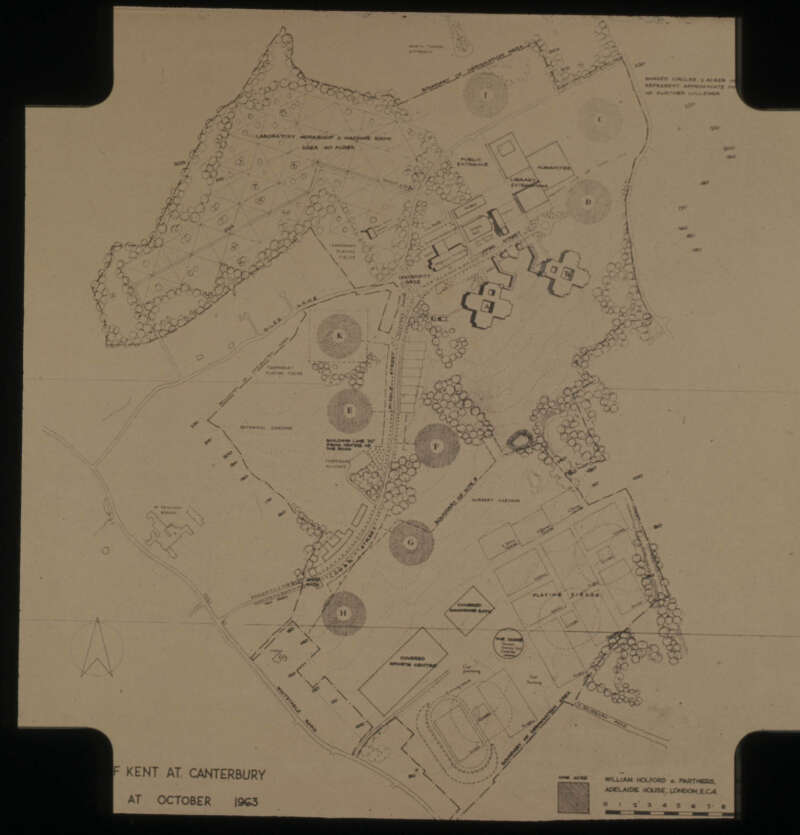
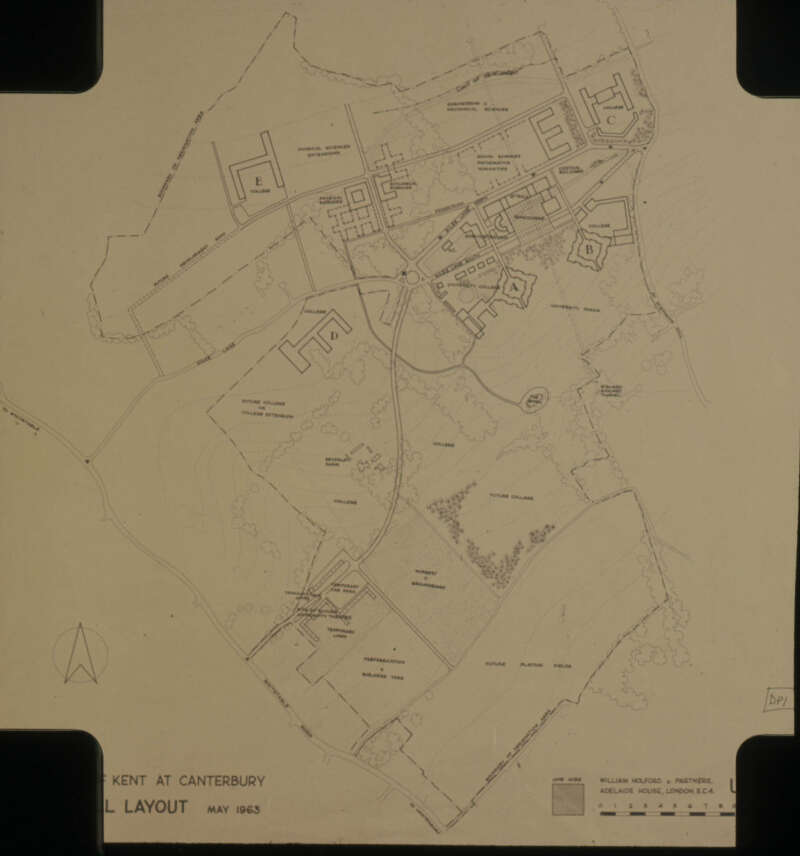
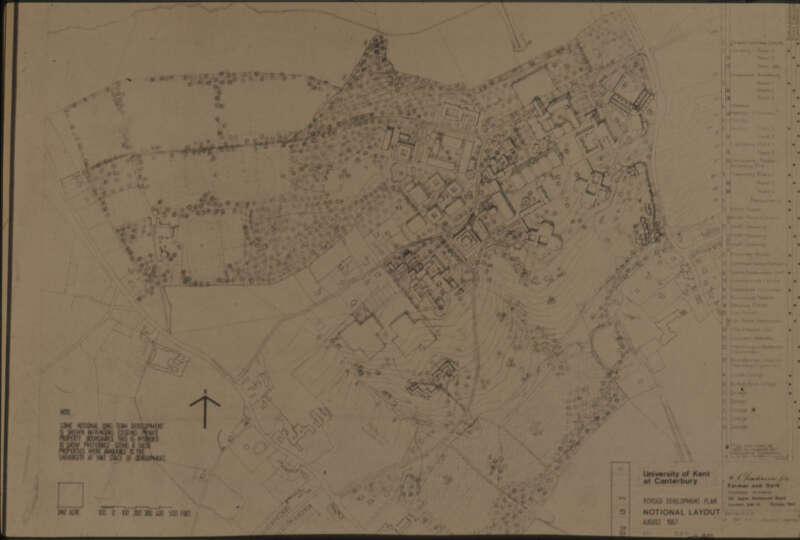
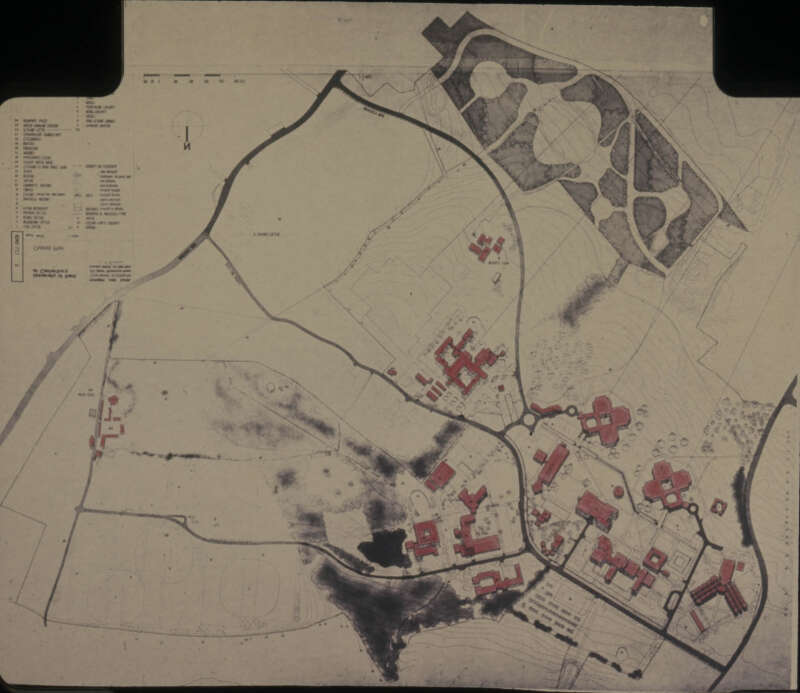
The establishment of a university
“The launching of the University reminds me in many ways of the launching of a ship: romance, high hopes and sound craftsmanship. She is to be the home and workplace of a company of men and women of varying views and skills, bonded together for a chain of voyages into the seas of knowledge. Guided by inherited wisdom she may make a series of familiar landfalls but the unpredictable is always around her and her prow points to new realms of thought”
- Lord Jo Grimond, Chancellor of the University of Kent from 1970 to 1990
On 18 May 1961, the government accepted the principle of establishing a university in Kent. Plans then moved guickly. An Academic Planning Board and Academic Sub-committee were established, Trustees were appointed, a Consultant Architect engaged, and Geoffrey Templeman appointed Vice-Chancellor. A nucleus of people gradually formed around him: Registrar, Surveyor, Bursar, first academic Professor Guy Chilver, followed by Deans, Masters and senior academic staff. Shortly thereafter, an Interim Committee was also formed, bringing together the Academic Planning Board and the Executive Committee of the Sponsors. It provided the foundation for what would become the University Council.
Choosing a site was one of the first major decisions. Several locations were considered, including Eastwell near Ashford, Palm Bay in Thanet, Bridge and two sites in Canterbury itself. One of the Canterbury sites was eventually selected due to its long association with scholarship and education, its attractive living environment and the infrastructure available to support a new university community.
The University of Kent was part of a new generation of ‘plate-glass’ universities established in the 1960s as part of a major expansion of higher education in Britain. The term, coined by academic Michael Beloff, reflected the modern architecture of these new universities, which often featured large areas of glass set within steel or concrete frames. This contrasted with the largely Victorian redbrick universities and those much older universities. Yet these new universities represented more than architectural change: they embodied an ambitious vision for higher education, with greater numbers of students, wider access and new approaches to teaching and research.

Did you know?
The University began the process of acquiring its own coat of arms soon after its foundation, through the College of Arms. The process was lengthy, and the University’s Letters Patent was finally granted in 1967.
The arms bring together symbols of Kent and Canterbury. The white horse comes from the arms of the County of Kent, while the three Cornish choughs, distinctive black birds with red bills and legs, are taken from the arms of the City of Canterbury, originally derived from the arms of Thomas Becket. The chough was also adopted as part of the Eliot College emblem by its first Master.
The crest depicts Canterbury’s West Gate, with the River Stour flowing below, and two golden Bishops’ Croziers arranged in the form of St Andrew’s Cross. The supporters are Cinque Ports lions, whose front ends are joined the stern a golden ship. The lions therefore have rudders instead of tails.
The University’s motto, Cui Servire Regnare Est, is taken from the Book of Common Prayer and means ‘Whose service is perfect freedom’.

Princess Marina: the University’s first chancellor
The Sponsors chose Princess Marina, Duchess of Kent as the University’s first Chancellor, following the tradition of appointing a member of the Royal Family or local aristocracy to the role. She was a unanimous choice and became a devoted supporter of the new University. Princess Marina, Duchess of Kent, was the widow of Prince George, Duke of Kent, and aunt of Queen Elizabeth II.
Princess Marina was not formally installed as Chancellor until 30 March 1966. On the same day, she also received an honorary degree, alongside then Archbishop of Canterbury, Dr Michael Ramsey, and John Haynes, Secretary of the University Sponsors.
Her support for the University went beyond her ceremonial role. Princess Marina, Queen Elizabeth II and the Queen Mother were jointly the largest independent donors to the University’s first Foundation Fund, contributing £100,000 in total, the equivalent of £2.5 million in 2026.
Princess Marina remained a committed supporter of the University until she sadly passed away in August 1968, shortly after she attended the University’s July Congregation.
Image: Princess Marina, Duchess of Kent leaving Eliot Hall after the degree congregation ceremony.

What's in a name?
Many of the buildings across the University of Kent campus are named after people who played an important role in the University’s history or made a lasting contribution to public life. Here are the stories behind some familiar building names on campus.
Named after Lord Wykeham Stanley Cornwallis the Lord Lieutenant of Kent and former chairman of Kent County Council. He was elected as the first chairman of the Sponsors of a University of Kent, the group who helped establish the University. He later became the University’s first Pro-Chancellor.
Opened in 1989 and named after Lord Joseph ‘Jo’ Grimond, former leader of the Liberal Party. He served as Chancellor of the University from 1970 to 1990, providing two decades of leadership following the death of the founding Chancellor, Princess Marina, Duchess of Kent.
Named in honour of Nelson Mandela, anti-apartheid campaigner and the first President of democratic South Africa in 1994. The name also reflects the University’s historical commitment to the anti-apartheid movement, with one of its earliest student societies dedicated to campaigning against apartheid.
Named after Geoffrey Templeman, the University’s first Vice-Chancellor (1963-1980). Prior to his appointment, he was a medieval historian and the Registrar of the University of Birmingham. He played a pivotal role in shaping the University’s academic vision and collegiate campus during its formative years.
Did you know?
The University was originally named the University of Kent at Canterbury. But choosing a name was far from straightforward. Initial proposals included University of Canterbury, University of Kent, University of Canterbury in Kent and University of Kent at Canterbury.
The debate took an unexpected turn when the University of Canterbury in New Zealand heard about the proposals. Concerned that another Commonwealth university might share its name, it wrote to express its dismay. The University Grants Committee (UGC) also raised concerns about using University of Canterbury.
After much discussion, University of Kent at Canterbury was chosen as the best option. The name was formally accepted by a meeting of the University’s Sponsors in October 1962.
On 1 April 2003, the University of Kent at Canterbury formally changed its name to the University of Kent. The logos shown here trace this evolution in name and identity, reflecting the University’s growth into an institution serving the wider county, alongside its expanding international links.

From past to present
From its beginnings on the outskirts of Canterbury, with around 500 students, 150 staff and a small number of buildings, the University of Kent has grown into an award-winning, globally recognised university across its two campuses in Canterbury and Medway.
Beyond its campuses, it has built strong connections with its students, staff, alumni and the towns it calls home. For more than 60 years, the University has played an important role in the educational, cultural and economic life of Kent, through the contribution of its students, staff and alumni.
Today, the University has an international presence, with partnerships across Africa, Asia Pacific, Europe, North America and South America. These partnerships support student and staff exchanges, dual and joint awards, and research and enterprise collaboration. It is recognised among the UK’s leading universities for apprenticeships and is ranked among the Top 50 universities for work experience.
The University also has a range of specialist institutes that coordinate and support multidisciplinary research. These include the Institute of Cultural and Creative Industries, Institute of Cyber Security for Society, Durrell Institute of Conservation and Ecology, and Institute of Health, Social Care and Wellbeing. Its students, staff and alumni contribute to the educational, cultural and economic life of Kent.
