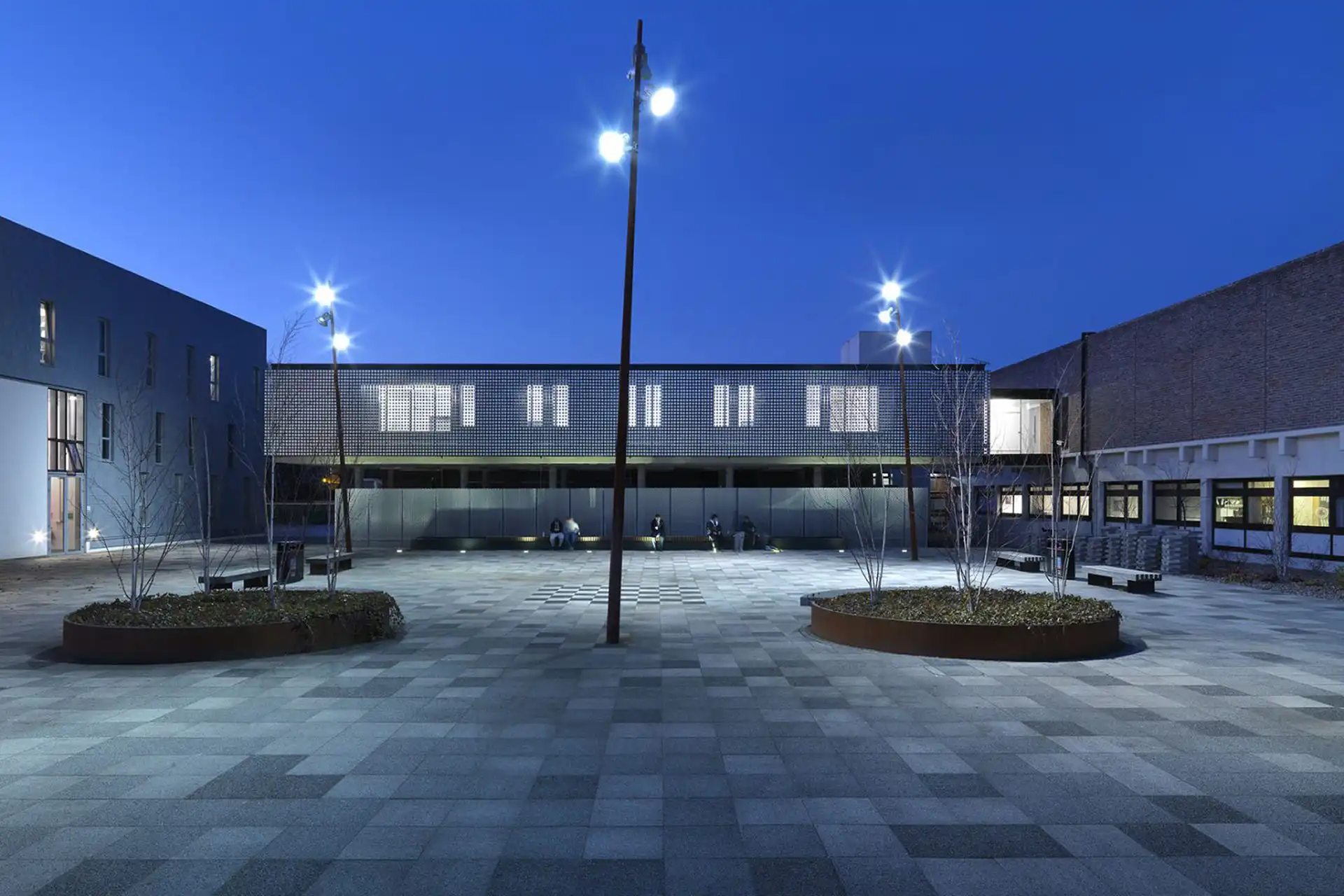
Kent School of Architecture


profile image for Mr David Haney

Mr David Haney

PhD (UPenn), MED (Yale), BARCH (UArk)

Architecture, Marlowe 106

Stage 2 Coordinator

David Haney is an architect with professional experience in historic building conservation, primarily on the US East Coast. His academic interests have always focussed on relationships between architecture and landscape.

His recent book, "When Modern was Green: Life and Work of Landscape Architect Leberecht Migge", is based on five years of research work undertaken while living in Berlin. This study is primarily a biography of the most important landscape architect for German modernism, Leberecht Migge (1881-1935), but it is also an introduction to several intersecting fields from the period, relatively undocumented in English language literature. Most significantly, this is the first study in English to reveal the importance of ecological thinking within German modernism. Haney's study shows that the roots of modernist philosophies are more complex than often thought, drawing upon varied sources such as alternative communities and international settlement movements. All of these phenomenon maintain contemporary relevance, connections that Dr. Haney is now exploring in his current research.

He has recently directed an undergraduate design studio focussed on ecological design and community. He organized a tour of the celebrated Findhorn Foundation, an ecovillage in Scotland, where students were able to see practices in action and meet with local residents, activists, and designers. The outcome of this studio was an ecovillage community centre, designed by individual students to incorporate sustainable architectural practice as well as ecological site use and design. He hopes to publish the result of this and similar future studio work as a study of both ecological practices and design pedagogy.

He has taught previously at Newcastle University (UK), The University of Pennsylvania (Philadelphia, US), and Yale (US). While at Newcastle he was a member of the Tectonic Cultures Research Group, and Chair of the School Library Committee.

back to top

Published research includes:

  • "When Modern was Green: Life and Work of Landscape Architect Leberecht Migge" London: New York: Routledge, 2010.

Articles and chapters:

  • "Organicism and the Reform of Garden Design and Urban Planning in Early Twentieth-Century Germany" with Elke Sohn (Hamburg), in "Biocentrism and Modernism", edited by Oliver Botar and Isabel Wünsche, Farnham (UK): Ashgate, 2010.
  • "Bringing the Americanized Pückler back to Germany: Charles Eliot and the German Park Reform Movement", "Bulletin of The German Historical Institute", Supplement 4, "Pückler in America", 2007 89-110.
  • "Leberecht Migge's 'Green Manifesto': Envisioning a Revolution of Gardens", "Landscape Journal" 2007 26(2): 201-218.
  • "Le Jardin de verre: fantaisies biotechniques dans l'oeuvre de Leberecht Migge (1881-1935)"; ("The Glass Garden: Bio-technic Fantasies in the Work of Leberecht Migge (1881-1935)"), eaV 2006/2007 12:72-83.
  • "'The Tree of Waste' ('Der Abfall Baum'):  Leberecht Migge's Concept of Biological Dwelling" David Haney, "Atık Ağacı’ Der Abfallbaum : Leberecht Migge’nin Biyolojik Yerleşim Kavramı", "Cogito" 200543:189-220.
  • "Two German Architectures", (Hamburg, July 2004). Exhibition Review, "Journal of the Society of Architectural Historians", June 2005.
  • Translation from French into English (entire book):  Roger Narboni, "Lighting the Landscape", Basel, Berlin:  Birkhäuser Publishers, 2004.
  • "No House-Building without Garden-Building:' the Modern Landscapes of Leberecht Migge", The Journal of Architectural Education, 2001 54/3: 149-157.
  • "To Live in the New World".  Judith Major.  Book Review, "Studies in the History of Gardens and Designed Landscapes", Oct-Dec 1998.
  • "The Legacy of the Picturesque at Mount Desert Island", "The Journal of Garden History", Oct-Dec 1996
back to top

Research interests:

  • Relationships between landscape and architecture
  • The history of sustainable and ecological design
  • The history of alternative communities and technologies as spatial practice
  • The Global Ecovillage Movement
  • The history of modernist open space
  • "Conservative" versus "modernist" attitudes in German landscape design history

Research affiliations

  • Society of Architectural Historians (US)
  • Society of Architectural Historians (GB)

Current projects include

A book-length study of alternative settlements and alternative technologies, beginning with late-nineteenth century examples, through to contemporary ecovillages, including examples in the UK and internationally. The purpose of this work is not solely to describe ecovillages as such, more importantly it represents part of an effort to understand that sustainable or ecological practices are not limited to technological/management problems, but are social acts, constitutive of daily life experience. The book is addressed to an audience ranging from academics, to professionals, to the interested public.

Translation from German into English of Leberecht Migge's 1913 book, Garden Culture of the 20th Century, projected to appear on the one-hundredth publication anniversary in 2013. This publication will include an introduction by Dr. Haney, setting in context what is surely one of the most important landscape treatises of the early twentieth century, incorporating contemporary urban planning and German Werkbund design theories.

Lectures

  • "Sorting Time: Cultural Landscape, Uses of History, and German Modernism," Conference paper for annual conference of the Society of Architectural Historians (US): April, 2009
  • "The English Country House and German Modernism: The Garden Architectonic", Northern Architectural History Society, Newcastle upon Tyne: February, 2009
  • "From Picturesque to Modern: The Hygenic Sublime and the Biological Garden" Guest lecture for the Landscape Architecture Programme, The University of Greenwich, London: May, 2008
  • "Bringing the Americanized Pückler back to Germany through the Writings of Werner Hegemann and Leberecht Migge", Conference paper for "Pückler in America," organized by the German Historical Institute, in Bad Muskau, Germany: June, 2006
  • "How Green was the Green Manifesto: Political Ambiguities in the Work of Leberecht Migge", Conference paper for annual conference of the Society of Architectural Historians (US): April, 2006.
  • “The Modern Garden in Germany 1900-1935: From Arts and Crafts to radical Biology" Guest lecture at École de Architecture Versailles: November, 2005.
  • "Bio-centrism and the Urban Landscape" Joint lecture (in German) with Elke Sohn, Hochschule der bildende Künste, Hamburg: May, 2004.
  • "Biological Theory and German Modern Architecture and Landscape" Seminar (in German): Landscape Architecture Dept., TU Berlin: January, 2004
  • "The Cramer House and the Eden Siedlung: Locations of Life Reform" Guest Lecture Stanford University Studies Center in Berlin: May, 2003
  • "The Modern Garden in Germany, 1900-1935", The Art History Department of Columbia University, Collins-Kaufmann Forum: September, 2002
  • "Agrar-Utopias and Domestic Colonization" Guest Lecture, Architecture Center, Santa Chiara, Italy: October, 2002
  • "Life-Reform and Architectural Reform in Germany, c. 1900" Guest lecture and tour, Dartmouth College in Berlin: April 2002
  • "The Small Garden as Polemic in the Work of Garden Architect Leberecht Migge" Guest lecture at the following schools in Germany (in German): Universität der Künste Berlin;Technische Universität Hannover; Hochschule für Bildende Künste Hamburg: December, 2001
  • "Modern Architecture and the Landscape in Germany" Graduate seminars at: University of Pennsylvania, Architecture: November, 1999; Columbia University, School of Architecture: January, 2000
back to top
Module Code Module Title Information
AR315 Oasis
  • Convenor
  • Tutor
AR316 Caravanserai
  • Convenor
  • Tutor
AR518 Building Appraisal
  • Tutor
AR532 Landscape 2
  • Tutor


back to top

Kent School of Architecture, Marlowe Building, University of Kent, Canterbury, Kent, CT2 7NR

The University of Kent, +44 (0)1227 824686 or architecture@kent.ac.uk

Last Updated: 02/10/2012