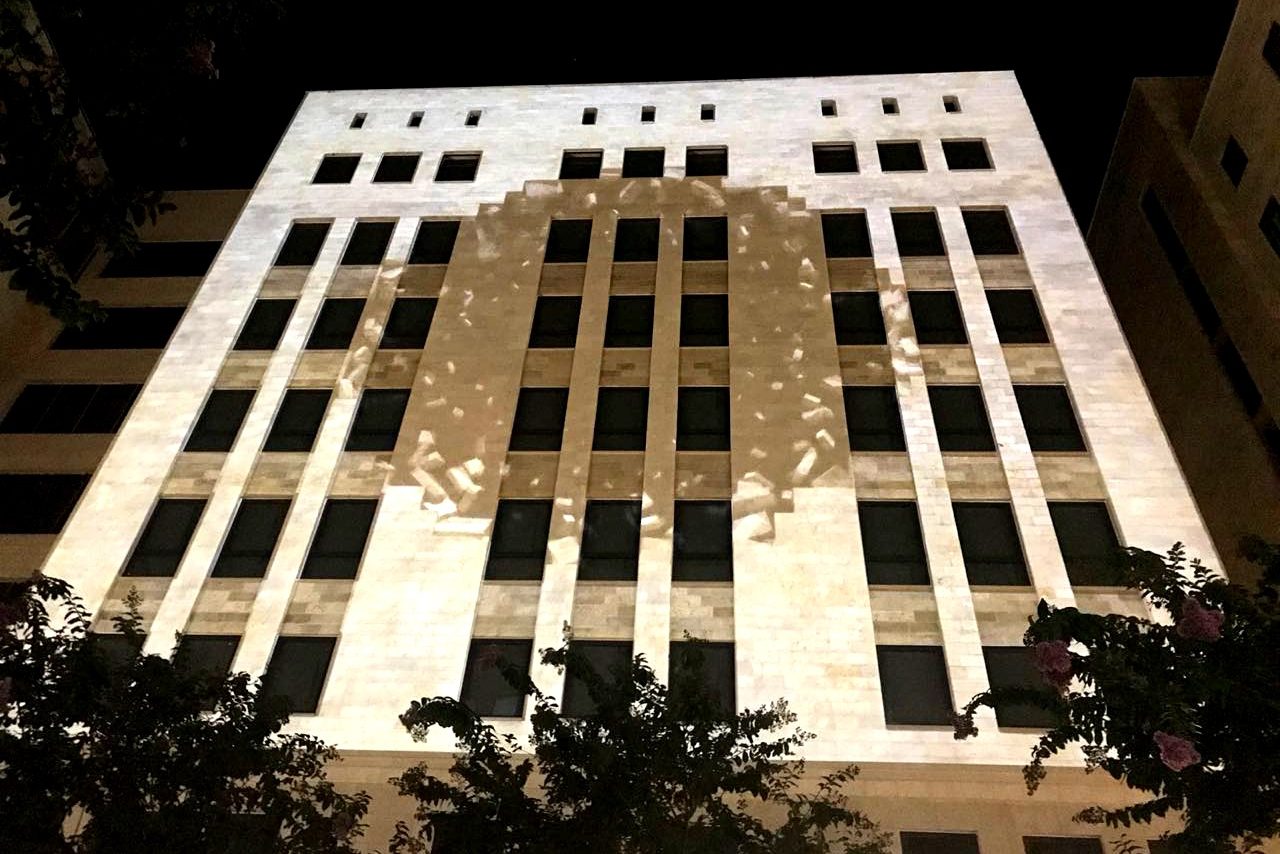
A Masters student from the Kent School of Architecture (KSA) at the University has achieved another personal ambition by being the first Palestinian to present an architectural projection-mapping work in the territory.
Projection mapping allows light to be mapped to specific surfaces and spaces through projection. This form of light installation delivers an added sense of spectacle, enabling onlookers to witness momentary changes to the urban canvas and engage with buildings in new ways.
Jihad Kmail, who is undertaking the MA Architectural Visualisation course projected traditional Palestinian imagery and graphics onto a new building in his home town of Rawabi in the build up to the Eid al-Adha holiday, which started on 21 August.
His projection aimed to show how Rawabi – a new town in the Palestinian Territories that is aiming to signal a new positive development for the state – can encapsulate its culture and heritage, whilst building for the future.
A video of the projection can be seen here.
Mr Kmail had already gained valuable experience with projection mapping at the Cheriton Light Festival in Kent during February 2018. This followed a KSA study tour to Lyon in December 2017 to witness the Fête des Lumières, the largest and most renowned light festival in the world.
He was accompanied by Howard Griffin, the Programme Director for KSA’s Architectural Visualisation. Mr Griffin said: ‘This was an incredibly successful event and the first time we have exported our work outside of the UK. The work allowed the residents of Rawabi and visitors to appreciate the positive direction the developers of the new town are hoping to take.’ Hundreds of people saw the projections over several days.
It is believed that Mr Kmail is the first Palestinian to have worked with projection mapping in his homeland. Before coming to Kent, he was poised to choose between pursuing architectural visualisation and projection mapping but through the introduction of Kent’s Virtual Cities module was able to pursue both interests on the same course.