Your results matter but they don't define your journey. Apply to Kent and we'll accept you even if you miss by 16 UCAS points.
Sign up for Priority Clearing
Sign up and you’ll get the chance to book a one-to-one chat with our Clearing team about your options and be the first to hear about available courses and events. On results day, you could also wake up to a Clearing offer already waiting for you.
Accreditation
This course is fully accredited by the Royal Society of Chemistry (RSC).
Gain crucial experience
Your Chemistry degree opens the door to lots of exciting careers; taking a Year in Industry helps you discover some of those options.
Take a global view
Spend a year studying abroad at one of our partner universities. We currently have links with institutions in the US, Canada, Hong Kong, Malaysia and Australia.
One of a kind
Get practical experience at Kent, home to the UK’s only VisionX Comparison Microscope and a dedicated ballistics facility.
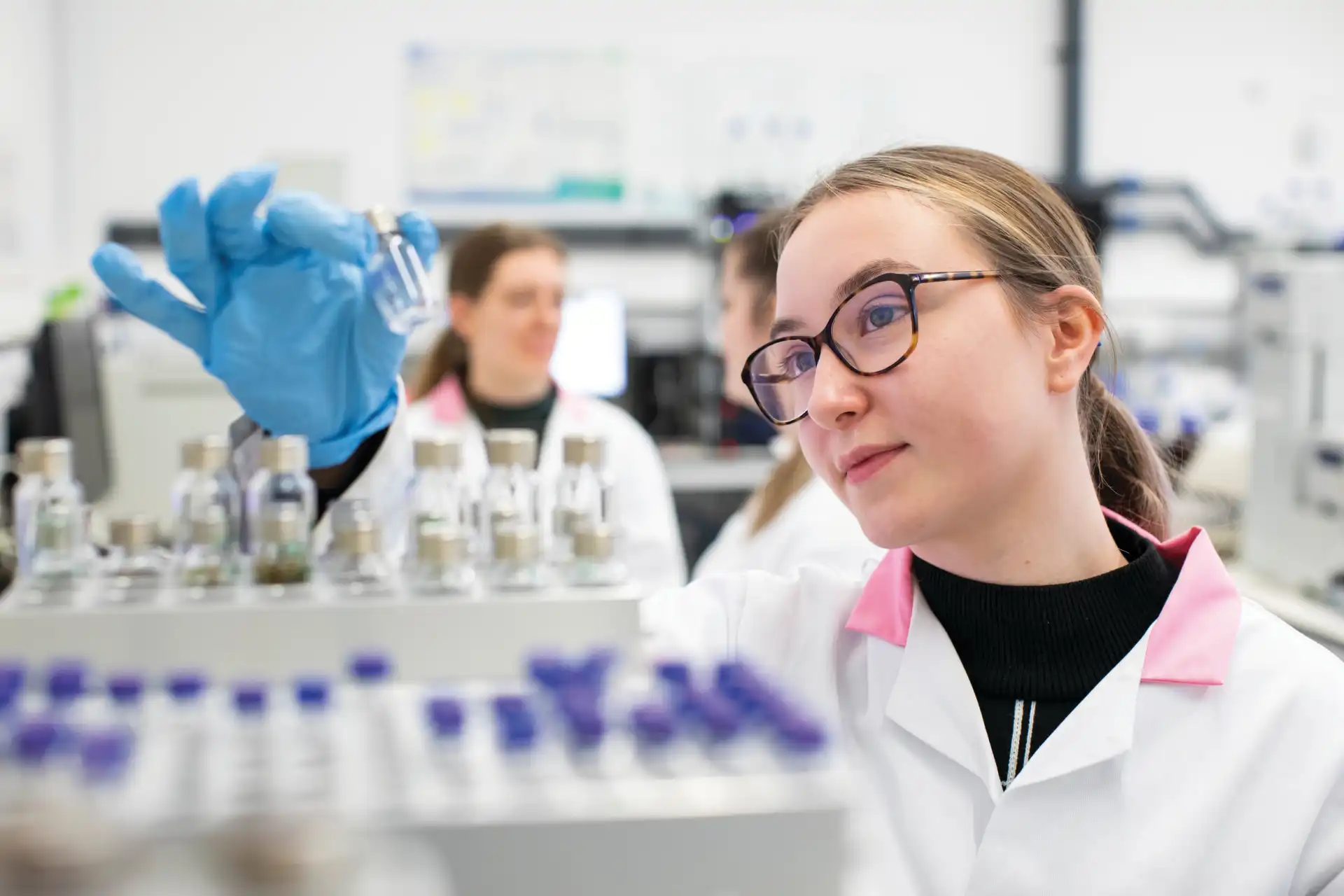
Curious about the structure of chemicals and the reactions they have with one another? Interested about how chemistry is applied across a range of forensic science disciplines? Enter the fascinating world of Chemistry with Forensic Science at Kent to gain the knowledge and practical skills in aid of tackling the challenges of the 21st century - from drug design and analysis to understanding the science that underpins and supports crime scene investigation.
Our distinctive course provides a carefully curated set of ‘chemistry in context’ modules where you will apply your skills and knowledge to interesting case studies and in the solution of real-world chemical and forensic science problems.
On your year in professional placement, you’ll work in industry for a year, gaining relevant work experience and putting into practice the skills you’ve learnt. The paid placement takes place between your second and final years and can be in the UK or abroad. You'll also produce an independent research project.
The course
You get to grips with the broad base of knowledge on which chemistry is founded, before further developing your knowledge of organic, inorganic and physical chemistry and your practical laboratory skills. In your final year you complete a research project.
What you'll study
Plot your course. Discover the modules you'll study on your Kent journey.
The following modules are what students typically study, but this may change year to year in response to new developments and innovations.
You'll work on the foundations of chemistry, before further developing your knowledge of organic, inorganic and physical chemistry alongside important practical laboratory skills.
Compulsory modules currently include the following
Embark on a fascinating journey into the heart of matter with our Fundamentals of Chemistry module, designed to ignite your curiosity and lay the foundations for your understanding of the chemical world. Delve into the fundamental principles that govern the behaviour of atoms and molecules, explore the mysteries of chemical reactions, and investigate the endless possibilities that chemistry offers in shaping our world. From understanding atomic structure to unraveling the complexities of bonding and reactivity, this course serves as a vital gateway, equipping you with indispensable knowledge essential for both forensic analysis and broader chemistry applications.
How do chemical and technological processes shape and influence the natural world? What can we as chemists do to tackle environmental challenges? As a burgeoning chemist, you will explore how chemical processes shape and influence the world around us. By fostering an understanding of environmental chemistry alongside essential skills in scientific communication, data analysis, and ethical conduct, this module equips you with the tools you need to tackle pressing environmental challenges and contribute to a sustainable future.
Why do we make molecules? Why does nature make molecules? What do these molecules do? What makes carbon so vital to life? What makes one molecule a medicine and another a poison? You'll start your journey in organic chemistry by answering some of these questions.
We'll introduce you to the basics of fundamental organic chemistry, looking at the structures of carbon-based molecules and how they can be put together in millions of different ways. We'll see how they bond with other elements to give complex compounds and how they can be made, synthetically and biologically. This module equips you with all you need to know about organic chemistry leading into your later studies in Chemistry or Forensic Science, laying the foundations for your degree and your career.
How do the elements vary across the periodic table? How can we utilise these variation to optimise the reactivity of compounds and their physical properties as is required by modern society? This module gives you an understanding of how the variation in bonding across the periodic table leads to predictable and useful trends in structure and properties.
The key properties of the transition metals are explored; this will enable you to understand how their fascinating and versatile properties arise, laying the groundwork for their application in diverse and distinctive settings. You'll develop your ability to understand and apply the key underpinning principles of inorganic chemistry supported by associated mathematical methods. This is key to the mastery of chemical structure, reactivity and functional properties required by chemists.
What drives a chemical reaction? How can we control chemical reactions? And why is it important to control chemical reactions? We discuss the key ideas of thermodynamics and kinetics in a chemical context. It shows how the universe may be understood in terms of the flow of energy, allowing us to understand what transformations are possible and how fast they will occur. These essential physical principles are then applied to real world phenomena, showing that even the most fundamental theories have direct and important applications in the modern world. This understanding is key to you not only become a successful chemist, but an ethical and responsible one, which is crucial when looking for a professional role following graduation.
Practising chemists are respected for their ability to understand complex theory, and test it experimentally. This module guides you through the introductory stages of your journey to competency in applied experimental chemistry. Comprising a rigorous set of practical experiences, you'll gain a robust understanding of core practical chemistry skills, from working hands-on skillfully in the wet laboratory, to venturing into the modern world of coding and computation. Along the way you'll explore organic and inorganic synthesis, physical and analytical chemistry, and the use of computational techniques in experimental chemistry, while developing key skills in data manipulation, data presentation and scientific report writing. This sets up up for an exciting and successful career as a chemist, or in a wider range of fields, putting you in the driving seat of your career.
Stage 2
In addition to core chemistry modules, you will immerse yourself in modules that provide specialist forensic science knowledge and application.
Compulsory modules currently include the following
Why is analytical chemistry important within the chemical and forensic industries? What approaches should we take when considering the chemical analysis of an unknown sample? Analytical chemistry is essential throughout the chemical and forensic world - covering not only how we design experiments to understand the composition of unknown samples, but also how we confirm and quantify results and assign a level of confidence to our findings. This module takes a pragmatic, application-driven approach to sample preparation, analysis, and data validation, providing key foundations for the modern analytical chemist - and the key skills needed for a number of careers in chemical and forensic industries.
Do you want to know more about the structure of DNA and how its structure has evolved to provide the building blocks of life? Have you wondered why different drugs behave in different ways inside our bodies? How do we create new treatments and therapies to tackle disease? This module introduces you to the key ideas and fundamental molecular components of biochemistry. You'll look at simple biomolecules and non-covalent interactions, building up to biological oligomers before you are introduced to key concepts in pharmacology and pharmacokinetics, illustrated with medicinal chemistry case studies. This application of theory into practice through examining case studies prepares you for a career where you can get hands-on and make a real difference.
Organic Chemistry is the science of making molecules. Understanding organic reactions helps scientists invent new drugs, discover eco-friendly materials, and decode the language of life. This module builds upon your knowledge of structure and reactivity and applies it in the context organic synthesis, molecular design, reaction mechanisms. You'll dive deeper into learning about creating more challenging target molecules from simple ones; along with industry-standard techniques to identify and follow the progress of any organic reaction. Upon completion, you'll be able to identify the most important concepts in the rational design of synthetic routes for useful complex organic molecules such as drugs, pesticides, dyestuffs, and perfumes. So you have the knowledge to launch a career in chemistry in a industry you are passionate about.
Explore the fascinating interplay between transition metals, organic molecules, and main group elements, unlocking the secrets behind some of the most pivotal chemical transformations shaping our world. From unraveling the intricate mechanisms of catalysis to harnessing the catalytic power of transition metal complexes, you'll delve deep into the frontiers of chemical innovation. You'll also gain an understanding of the rich structural and chemical diversity of inorganic solid-state compounds that enable their applications as functional materials. This further builds on your knowledge of inorganic chemistry and gives you the tools you need for a successful and exciting career as a chemist.
As a forensic scientist, what would you do if someone comes across buried human remains? How do we collect evidence from a scene, document it and ensure we maintain a clear legal chain of custody? Why should we care about this? This module will develop your appreciation of a range of physical techniques applied to the collection of bulk and trace evidence materials in forensic science.
You'll look deeply into aspects of physical evidence, practical issues of item examination, legal process and general procedures associated with the collection and submission of a range of forensically-relevant materials. You'll also look at the processes that underpin the recovery of buried remains and how you being to analyse these to build a biological profile. This provides you with a broad understanding of scene and evidence processing to take forward into a future roles in practical forensic science.
The modern forensic chemist must operate successfully across a range of forensic and chemical disciplines, applying core knowledge to a range of unfamiliar problems. You'll venture through a diverse and challenging range of practical forensic, chemical and theoretical experiences as you develop your incident scene investigation skills, applying skills in evidence retrieval, preservation and documentation.
The experiments you conductwill cross many disciplines to illustrate the multi-faceted, versatile, and employable characteristics of a practising forensic chemist. You'll complete the module with more confidence working alone and in groups, with the knowledge and abilities to carry out, understand, analyse, evaluate, improve, and report on your forensic science and chemistry practical work. The range of skills you develop during this module will critically underpin success in the remainder of your studies and beyond.
Tom Tillin
My year in industry couldn’t have gone better. I secured a role at IBM, working in their sports and entertainment department – it was perfect for me
After successfully completing stage 1 at your first attempt, with an average pass mark of at least 60%, you have the opportunity to spend a year in industry between Stages 2 and 3. We give advice and guidance on finding a placement.
Please note that acceptance onto the course is not a guarantee of a placement. The responsibility of finding a placement is on the student, with help and support from the department. If you cannot find a placement, you will be required to change your registration for the equivalent BSc programme without the Year in Industry option.
You take all compulsory modules then choose either FSCI6010 Fires and Explosions or FSCI6003 DNA Analysis & Interpretation. Alongside your modules, you also complete an independent research project.
Compulsory modules currently include the following
Modern Chemistry and Forensic Science rely heavily on a suite of chromatographic and spectroscopic techniques. But which of these should we apply for our particular cutting-edge chemical research, or to obtain the specific, precise and robust forensic evidence we require?
This module builds upon your knowledge of fundamental concepts and methods to understand the specificity, advantages and limitations of these more advanced techniques, and explore approaches to best apply them across a broad range of applications. Using this knowledge, you'll strategically choose and expertly apply advanced analytical methods across a range of scenarios explored elsewhere within your course.
Beyond this course, you can apply these interdisciplinary skills and technologies to pioneering research and in support of impacting real world issues in fields including environmental chemistry, forensic trace analysis and pharmaceutical development and detection.
What’s the importance of organic synthesis? Why should we learn about different organic processes? Organic synthesis is key to the success of multiple industries such as medical and pharmaceutical. In this module, we'll explore advanced complex methods for different organic transformations bringing together the beauty and complexity of organic chemistry. You'll also broaden and extend your knowledge of organic chemistry to standards used in modern chemistry research, academia, pharmaceutical science, and other related industries. You'll study the principles to master various bond formations and functional group transformations at an advanced level, gaining the essential skills you need to pursue a career in organic chemistry.
How can we apply our chemical knowledge and problem solving techniques to original chemistry challenges? How can we innovate within the chemical sciences to build on the knowledge base within our scientific and global communities?
You'll undertake a comprehensive research project, selected from a range of chemical disciplines. You will also gain skills in conducting and directing scientific research, data analysis and interpretation, problem solving and communication of results, culminating in the writing of your dissertation. This isn't just your chance to hone you skills and develop as a chemist, your dissertation itself is a real piece of scientific research you can use to demonstrate your knowledge and skills to employers following graduation.
What properties of a material define its value as trace evidence? How can we use this understanding to shape our approach to collecting and analysing these evidence types?
Understanding trace evidence is of fundamental importance to Forensic Science, providing links between people and locations or objects. In this advanced module you will delve into the analytical techniques and chemical principles critical for examining trace materials. From fibres and hair to glass fragments and makeup, you'll uncover the stories hidden in the smallest samples. Through discussion of real-world case studies and studying cutting edge approaches to analysing complex and inconsistent samples, you'll build the expertise to enable you to interpret this vital evidence type.
Why is it important to understand the influence of bias within forensic science? What are the expected professional standard for a practicing forensic scientists? How do forensic laboratories adhere to the strict standards the legal system expects of them? What is it like to give evidence in a court of law?
This module illustrates a range of contemporary topics in forensic science that underpin professional practice for those students wishing to enter the forensic science profession. The module content draws upon guidance published by the UK Forensic Science Regulator, UKAS, ENFSI, CSFS as well as academic and professional commentary, with a particular emphasise on evaluative reporting, case assessment and interpretation (CAI), quality standards, ethics in forensic science and bias.
You will be provided training in writing expert witness court reports before undergoing a mock courtroom exercise during which you will deliver expert testimony in a courtroom environment, developing essential skills for future case reporting forensic scientists.
Optional modules may include the following
What causes a fire to rage out of control? What makes an explosion so destructive? How do we gather and analyse evidence we normally rely upon from a scene that may have been compromised by a powerful blaze or destructive explosion?
This advanced module develops your understanding of the chemical and physical processes that drive fires and explosions. You'll learn how to identify accelerants, detonators and types of explosives, reconstruct fire scenes and develop insights as to the nature of fires and explosions, allowing you to formulate expert opinions based on your findings. You’ll also learn about how best to apply specialist analytical techniques for the analysis of fire and explosive evidence.
Forensic science and DNA have been inseparable topics for decades, but what role does DNA play in forensic science? You'll look at the structure of DNA and the powerful techniques we use to analyse this important evidence type within a forensic context. You'll gain a critical understanding of practical considerations in genetic analysis, the challenges associated with results interpretation and how best to report on complex samples. You'll not only gain mastery of DNA analysis techniques but also investigate profound insights into their application in the captivating field of forensic science, all while exploring the intriguing ethical quandaries connected with deciphering genetic information.
How you'll study
This course combines innovative teaching with extensive practical sessions, where you can apply your knowledge.
Lectures
Seminars
Tutorials
Independent Study
Workshops
Lab Work
×
Teaching and assessment
The degree is made of a combination of lectures, laboratory classes, project work and problem solving seminars.
Assessment is by a combination of written examinations, continuous assessment and other assignments. You must pass the Stage 1 examinations in order to go on to Stage 2. The year in industry mark also counts towards your final degree result.
Coursework assessments include practical laboratory skills, presentation skills as well as essay and report writing.
Please note that there are degree thresholds at stage 1 that you will be required to pass in order to continue onto the next stages.
Here’s a sample timetable from your first term at Kent. You'll learn through a mix of lectures, seminars and workshops - in both big and small groups with focused teaching blocks and time to work, rest or explore uni life.
Items in green are confirmed, whereas anything marked yellow could be scheduled at a different time or day depending on your group, but this gives a good sense of what to expect.
✅ A balanced timetable that works for you
Plan your week better: at least one free weekday for catching up on course work or just taking a breather.
Focused days without burnout: No isolated 1-hour campus days.
Time to live the uni experience: Space for societies, part-time jobs and downtime.
The University welcomes applications from international students. Our international recruitment team can guide you on entry requirements. See our International Student website for further information about entry requirements for your country.
If you need to increase your level of science ready for undergraduate study, we offer a Foundation Year programme which can help boost your previous scientific experience.
Meet our staff in your country
For more advice about applying to Kent, you can meet our staff at a range of international events.
English Language Requirements
This course requires a Good level of English language, equivalent to B2 on CEFR.
IB Standard Level Grade 5 or above in English A: Language and Literature
A Level Grade C or above in English Language or English Literature.
×
Entry requirements
The University will consider applications from students holding a wide range of qualifications. Click below to find out more.
Typical offer levels
All applications are assessed on an individual basis but some of our typical requirements are listed below. Students offering qualifications not listed are welcome to contact our Admissions Team for further advice. Please also see our general entry requirements.
Additional requirements
96-112
BBC including Chemistry, Biology or Physics at B
The University will consider applicants holding/studying BTEC Extended National Diploma Qualifications (QCF; NQF;OCR) in Applied Science at DMM.
112 Tariff points, Typically H5, H5, H6 at HL including HL Chemistry, Biology or Physics at 5
Mathematics grade C or 4
Other qualifications
N/A
The University will consider applicants holding T level qualifications in subjects closely aligned to the course.
The University welcomes applications from Access to Higher Education Diploma candidates. for consideration. A typical offer may require you to obtain a proportion of Level 3 credits in relevant subjects at merit grade or above. A typical offer for stage 1 would be: Access to HE Diploma 45 at level 3 Credits with 18 credits at Distinction and 24 credits at Merit and contain at least 12 Level 3 credits in Chemistry. A science programme including Chemistry Level 3 credits would be required.
Fees and funding
Tuition fees for 2026 entry
The Government has confirmed that tuition fees in England for Home students will increase to £9,790 from £9,535 for the academic year 2026/27.
Tuition fees may be increased in the second and subsequent years of your course. Detailed information on possible future increases in tuition fees is contained in the Tuition Fees Increase Policy.
For details of when and how to pay fees and charges, please see our Student Finance Guide.
UK
International
Full-time (UK)
TBC
Full-time (International)
TBC
Fees for year in industry
Fees for undergraduate students are £1,955.
Fees for year abroad
Fees for undergraduate students are £1,465.
Your fee status
The University will assess your fee status as part of the application process. If you are uncertain about your fee status you may wish to seek advice from UKCISA before applying.
For details of when and how to pay fees and charges, please see our Student Finance Guide.
Students will require regular access to a desktop computer/laptop with an internet connection to use the University of Kent’s online resources and systems. Please see information about the minimum computer requirements for study.
There may be additional costs associated with the Year in Industry such as travel or accommodation, which will need to be covered by the student. Please see Careers and Employability webpages for more information.
You'll graduate with an excellent grounding in scientific knowledge and
extensive laboratory experience, as well as a toolbox of transferable skills highly sought after by employers. These include excellent communication and problem-solving skills; the ability to work independently or as part of a team; analytical thinking; and effective time management. Typical graduate destinations include:
Concept Life Sciences
GSK
Ministry of Defence
Pfizer
Reckitt
SG Technologies Ltd
teaching.
Graduates entering high-skill roles can earn up to
48%
more than non-graduates. - WEF Future of Jobs Report 2025
A degree can boost average lifetime earnings by over