Sign up and you’ll get the chance to book a one-to-one chat with our Clearing team about your options and be the first to hear about available courses and events. On results day, you could also wake up to a Clearing offer already waiting for you.
Reach for the stars
Combine astrophysics learning with a strong focus on space exploration, including subjects such as spacecraft and mission design, star formation, and astrobiology.
Tackle real challenges
Our projects are shaped by real industry problems, from optimising radiotherapy treatments to evaluating UK spaceport locations.
Step up to an MPhys
Add a fourth year to this BSc course to gain the skills you need for more technical and research roles.
Fully-accredited learning
Our course meets the highest standards of learning and is accredited by the Institute of Physics.
There's still time to join us this September. Call the hotline now or apply online to secure your place and take the next step towards Your Kent Start.
Investigate the possibilities of life elsewhere within the universe and get involved with real space missions from ESA and NASA. You'll also work on Hubble Telescope data and images from giant telescopes, as well as working with our own Beacon Observatory.
Access our first-class research laboratories, which are equipped for synthetic and analytical techniques ranging from soft organic polymers to nanoparticles, to highly sensitive organometallic species.
Adding a professional placement year to your degree allows you to gain valuable work experience. Your placement can take place in the UK or abroad and many pay a salary.
Develop the transferable skills to open up a world of job opportunities, leading to careers in research, engineering, aerospace/defence, medical physics, teaching, finance and data analytics.
If you don’t have a science background or don’t meet our entry requirements, you can take our foundation year.
Do you want to focus on physics?
If you'd like to understand our world at a fundamental level, from the smallest sub-atomic particles to the large-scale structure of the universe, you'll be interested in our Physics course.
Accreditation
This course is fully accredited by the Institute of Physics.
The course
Start by building the fundamentals of physics, mathematics and astronomy, and then channel that knowledge into the specialist study of space science. You’ll demonstrate your understanding through projects, and an in-depth final year research task.
What you'll study
The following modules are what students typically study, but this may change year to year in response to new developments and innovations.
You’ll focus on the fundamentals of mathematics, physics and astronomy.
Compulsory modules currently include the following
To ensure you make rapid progress in physics, you need to understand mathematics. You’ll undertake an in-depth study of calculus, complex numbers and vector mathematics, as well as statistical methods for data analysis.
Through the calculus component, you will delve into the fundamental principles of differentiation and integration, emphasising their relevance in physics applications. This foundation will pave the way for mastering key techniques directly applicable to physics problems and scenarios. Additionally, you will be introduced to scientific programming in Python, expanding your horizons in the application of computer and IT packages used to build mathematical models of physical behaviour.
This gives you the skills, knowledge and confidence you need to go on in your degree and produce your best work both now, and later in your career.
You’ll dive into all the important topics in astronomy, optics and special relativity using straightforward mathematics to help you master the concepts.
You’ll study light focussing on the key principles of geometrical optics, and how they allow us to design and understand instruments including astronomical telescopes. This will lead into an exploration of important topics in modern astronomy, such as determining distances and observational properties of stars, beginning with our own solar system and extending to objects at the very limits of the observable universe.
You’ll also receive an introduction to the fascinating subject of special relativity, encountering concepts such as space-time, time dilation and the relativity of simultaneity. After completing this module, you’ll be well-prepared for more advanced topics in astrophysics, optics and theoretical physics.
Building on your knowledge developed through ‘Mathematics I’ you’ll explore key mathematical techniques involving multiple independent variables. These include the topics of differential equations, multivariate calculus, non-Cartesian coordinates, and vector calculus that are needed for further study in physics.
Use of numerical approaches towards mathematical problem-solving is also introduced, demonstrating use of computational algorithms and techniques to solve diverse problems and graphically present and interpret data. This further exploration of mathematics gives you the skills you need to explore pressing questions throughout the universe and sets you up for further study, and later, your career.
This is your chance to get hands-on through a series of experiments giving you experience in using laboratory apparatus and equipment. This will also teach you how to accurately record and analyse data in laboratory notebooks and write scientific laboratory reports. You’ll carry out experiments covering subjects found in the Physics degree program and are run parallel with Computing Skills workshops in which you will be introduced to the fundamentals of using programming/scripting, and its application to analyse and report data from their experiments.
By completing this module, you’ll become a competent user of experimental, computational and communication tools, understanding the inherent uncertainties of empirical science and what this means in relation to scientific findings, and knowing the standards expected of you in reporting scientific results, in readiness for more advanced laboratory work.
Embark on an exciting and comprehensive journey into the intricate world of motion, energy, and momenta and thoroughly understand the fundamental laws of motion, including the mathematical principles underpinning them.
Explore concepts such as momentum, energy, rotational motion, angular momentum, and gravitational forces, and gain an appreciation of the mathematical description of harmonic oscillations and learn how to apply them to real-world scenarios. In addition to these core topics, you’ll cover a range of related subjects essential for understanding key concepts in physics and how they underpin natural phenomena. Through delving into associated areas such as static equilibrium, elastic properties of objects, and fluid mechanics, you’ll gain a deeper understanding of the physical world and make connections between seemingly disparate phenomena.
With a solid foundation in these concepts, you’ll be well-equipped to launch careers in engineering, technology, and other fields that require a strong understanding of fundamental physics principles.
You’ll explore waves, fields and the quantum world through two parts, giving you the chance to make rapid progress and get the knowledge you need for further investigation and exploration.
The first part of the module introduces you to electric fields, magnetic fields, and electro-magnetic phenomena including the behaviour of electric circuits and electromagnetic radiation. This will culminate in a fundamental, classical understanding of light as an electromagnetic wave, connecting what you have learned about optics with your knowledge of waves from earlier modules.
The second part of the module breaks out of the mould of Classical Physics to introduce its successor, Quantum Physics, according to which light can behave as discrete units. You’ll also explore how a new type of wave, called a "wave function", can be used to describe the behaviour not of light, but of particles. This is what will set you up for a fuller exploration of the quantum world later in your studies, opening up a whole universe of possibilities.
Stage 2
You’ll learn a broad range of subjects such as the multiwavelength universe and exoplanets, spacecraft design and operations, atomic and nuclear physics, and quantum physics.
Compulsory modules currently include the following
Mathematical techniques are essential for solving problems in physics and related fields. You will gain comprehensive grounding in the mathematical methods necessary for solving differential equations, understanding special functions, and conducting harmonic analysis. You’ll also get a grounding in numerical methods and asymptotic analysis, preparing students for the analytical challenges they will encounter in their studies and professional lives.
Building on a strong mathematical foundation for further study and research, the skills you develop will not only benefit you academically but also enhance your employability, preparing you for technical roles in research, engineering, data analysis, and beyond, where rigorous mathematical reasoning and problem-solving abilities are highly valued by employers.
Modern science is a collaborative effort, requiring physicists to work in teams of varying sizes, and to communicate their results to a wide range of audiences. We ensure you will develop your ability to conduct complex investigations as a team, and to disseminate your outcomes.
You’ll do this through producing more comprehensive written reports and using computational scripts to analyse and visualise data. A key focus is on analysis of experimental uncertainties and comparison with underlying physical theories. Your team-working skills will be developed through a group project focused on a real, open-ended research topic, with problems chosen from a list drawn from the research interests of academics, problems set by industry, and areas such as physics education and outreach.
The skills developed in this module will help prepare you for more in-depth investigations later in your degree and for collaborative working in your future career.
Dive into the fascinating world of quantum mechanics, where you will develop a comprehensive understanding of wave functions, the Schrödinger equation, and quantum numbers, essential for describing the properties of key physical systems.
This module introduces you to critical terminology and mathematical concepts fundamental to quantum mechanics, such as eigenstates, eigenvalues, and expectation values. You will explore the Schrödinger equation through various important systems, including two-state systems, particles in simple potentials, and the simple harmonic oscillator. You will also learn how to use the Schrödinger equation in different coordinate systems to understand the concept of angular momentum in quantum mechanics.
In the realm of atomic physics, you will investigate solutions for atoms, with a particular focus on the hydrogen atom, and study their interactions with electromagnetic radiation. These methods extend to the study of molecules and nuclei, providing a robust framework for understanding a wide range of physical phenomena.
This module offers a detailed and accurate portrayal of atomic structures, which are the fundamental building blocks of numerous physical processes and phenomena.
Electromagnetism and Relativity are two fundamental classical theories in Physics. You'll be introduced to a range of important laws and principles that lay the foundation for studies in these fields. You'll develop an understanding of magnetic and electric fields and how to apply Maxwell’s laws to describe all phenomena involving electromagnetic waves (from radio waves to visible light, X-rays and gamma rays).
Once the propagation of light has been discussed and understood in the context of Electromagnetism, you will study the consequences of the constant velocity of light in the context of Einstein’s theory of Special Relativity. The theory will be applied to understanding concepts such as time dilation and event horizon.
You'll acquire a deeper understanding of highly formalised theories, and how these are powerful tools to solve a diverse range of problems. You'll also develop your skills for formal reasoning and fundamental mathematical tools (vector fields in particular), applying these to solve problems in the context of the systems studied in the module and will contribute to the skills set of a physicist for your future career.
Build on the introduction to astronomy taught in earlier stages. You will enhance your knowledge of astrophysics through the study of the theory, formalism and fundamental principles, developing a rigorous grounding in observational, computational and theoretical aspects of astrophysics.
In particular, you will study topics such as properties of galaxies and stars, the detection of planets outside the solar system, and CCD cameras. There is the opportunity to take part in observations with the Beacon Observatory. This deepening of your knowledge and practical, hands-on experience in astronomy is valuable for you to kick-start a career in the field.
How can we use space to benefit our society on Earth and to explore our solar system and beyond? On this module you'll discuss the design and operations of spacecraft, including satellites, to explore answers to these questions. We'll introduce the harsh environment of space, the hazards posed to spacecraft, and how we design spacecraft to overcome these challenges. You'll also develop your understanding of the major subsystems of a spacecraft through the study of the theory, formalism and fundamental principles, as well as the framework to understand spacecraft trajectories and orbits.
As humanity seeks to both explore and establish bases beyond Earth you'll consider the additional scientific and technical challenges of crewed space flight and establishing extraterrestrial habitats. The course also discusses how space missions are designed, funded and managed. Join the next generation of physicists looking to journey further into the cosmos and unlock the secrets of the universe.
Tom Tillin
My year in industry couldn’t have gone better. I secured a role at IBM, working in their sports and entertainment department – it was perfect for me
After successfully completing stage 1 at your first attempt, with an average pass mark of at least 60%, you have the opportunity to spend a year in industry between your second and final years of study, with support and advice from the University.
Please note that acceptance onto the course is not a guarantee of a placement. The responsibility of finding a placement is on the student, with help and support from the department. If you cannot find a placement, you will be required to change your registration for the equivalent BSc programme without the Year in Industry option.
In your final year, a combination of specialist modules and laboratory work on individual and group projects opens avenues for even deeper exploration: for example, stars, galaxies and the Universe, the Sun, the Earth and Mars and more.
Compulsory modules currently include the following
All modern technologies rely on the use of light in some way or another, which makes understanding light absolutely essential. This module provides you with an immersive experience, allowing you to discover fundamental and contemporary concepts that shape our understanding of how light interacts with matter. You'll explore the practical applications of optics and photonics in various fields, such as telecommunications, medicine, manufacturing, and computing, giving you experience aligned with a range of potential careers.
Throughout the module, you'll acquire knowledge and skills in designing and analysing optical systems, becoming proficient in using tools such as lasers and fibre optics and enhancing your problem-solving skills. In doing so, you'll understand how your developing expertise can be applied in practice, including in multi-disciplinary or multi-professional contexts, to make a positive difference to the world around you.
Explore the classic theory of thermodynamics and how the thermal properties of physical objects can be described in terms of their microscopic properties through the application of statistical mechanics. You'll learn the three laws of thermodynamics and how to use them to understand physical phenomena, such as the conversion of heat into work in an engine or the cooling cycle in a refrigerator.
You'll learn how to derive measurable, bulk properties such as temperature, heat capacity, entropy or magnetisation from the behaviour of the microscopic components in a gas or a paramagnet. Statistical mechanics bridges the gap between the microscopic and macroscopic description of the physical world; you'll apply theoretical principles, alongside a range of mathematical skills, to contemporary issues such as how heat pumps work, the effect of temperature on defects in a crystalline solid, heat capacity due to electrons in a metal, to address real-world problems and potential solutions.
Building on your studies in observational astronomy, this module provides a balanced and rigorous course in astrophysics for BSc students. You'll develop and enhance your knowledge of astrophysics through the study of the theory, formalism, and fundamental principles.
You'll also delve into the equations describing the internal structure of stars, energy transport mechanisms, nuclear fusion processes, and the evolution of stars off the main sequence. The second half of the module explores topics such as high-redshift galaxies, galaxy clusters, and active galactic nuclei (AGN), general relativity, cosmological principles, the age and stages of the universe, dark matter, dark energy, and the cosmic microwave background.
You'll finish the module having embarked on a thrilling journey through the cosmos, equipped with essential skills and understanding needed for astronomy at a professional level and be on a firm footing should you wish to pursue further studies in astrophysics at MPhys level and beyond.
If you want to explore beyond earth, your the first step is our solar system. You'll get to grips with our closest neighbors, the composition of the Sun and planets will be placed in the context of the current understanding of the evolution of the Solar System. You'll also study solar terrestrial physics, learning how interactions between the Sun and Earth affect life on our planet. You will then move on to look at the terrestrial planets and the processes that have shaped them, learning first about the Earth before considering Mars, Mercury and Venus.
By the end of this module, you'll have achieved a solid understanding of the interplay of the Sun and its planetary system, and be equipped with analytical skills and interdisciplinary knowledge applicable to fields including not only planetary science but also remote sensing, environmental and earth science and space exploration.
Explore the constituents of matter and how the structured arrangement of atoms in a solid gives rise to their properties. You'll start by looking at the structure and properties of the nucleus, as well as its stability and fission and fusion processes. You'll then study how the regular arrangement of atoms in a lattice gives rise to crystalline solids and proceed to investigate how the behaviour of electrons in crystals is responsible for many of the properties we find in the materials driving technology (such as metals, semiconductors, magnetic materials). The theoretical principles taught in the lectures, as well as a range of mathematical skills, will be applied to solving problems, including those related to electronics and optoelectronic devices.
How are data processing and analysis techniques applied to astronomical data from telescopes? You'll learn how telescopes and CCD cameras work, and how they process astronomical images and spectra. You'll also apply a range of data analysis and machine learning techniques using software packages.
As part of your project work, you can engage in the scientific interpretation of images and spectra of astronomical objects or numerical modelling results. You'll get to take part in at least two observing nights with our Beacon Observatory. This on-campus facility offers hands-on astronomical experience with a research-grade dome and telescope, enhancing the quality of your degree experience and better preparing you for a career in the space and astronomy sector.
This module provides a practical underpinning to the theoretical astrophysics work in other modules. Working through the experiments provided, using authentic data, will leave you with a richer appreciation and understanding of this subject matter, equipping you with the skills to succeed as working astronomers that are, in addition, transferable to many other professional disciplines.
How you'll study
You’ll receive extensive practical training in our labs and understand the real-world applications of what you learn. Practical sessions are supplemented with a range of teaching and learning methods, including lectures and laboratory classes, computing sessions and team projects.
Lectures
Seminars
Tutorials
Independent Study
Workshops
Lab Work
×
Teaching and assessment
Teaching is by lecture, laboratory sessions, and project and console classes. In addition, you have reading and coursework and practical reports to prepare. For the year in industry you write a final report of the work you did during the placement and, on returning to Kent for your final year of study, present a lecture on your experiences.
A variety of assessment methods are used as appropriate, including coursework/workshop assignments, written unseen examinations, laboratory and project reports and presentations. Your final degree result is made up of a combined mark from the Stage 2 and 3 assessments and your year in industry, with maximum weight applied to the final stage.
Here’s a sample timetable from your first term at Kent. You'll learn through a mix of lectures, seminars and workshops - in both big and small groups with focused teaching blocks and time to work, rest or explore uni life.
Items in green are confirmed, whereas anything marked yellow could be scheduled at a different time or day depending on your group, but this gives a good sense of what to expect.
✅ A balanced timetable that works for you
Plan your week better: at least one free weekday for catching up on course work or just taking a breather.
Focused days without burnout: No isolated 1-hour campus days.
Time to live the uni experience: Space for societies, part-time jobs and downtime.
Join a thriving industry
Develop the knowledge and skills necessary to launch a range of careers, from operating satellites to space entrepreneurship.
State-of-the-art facilities
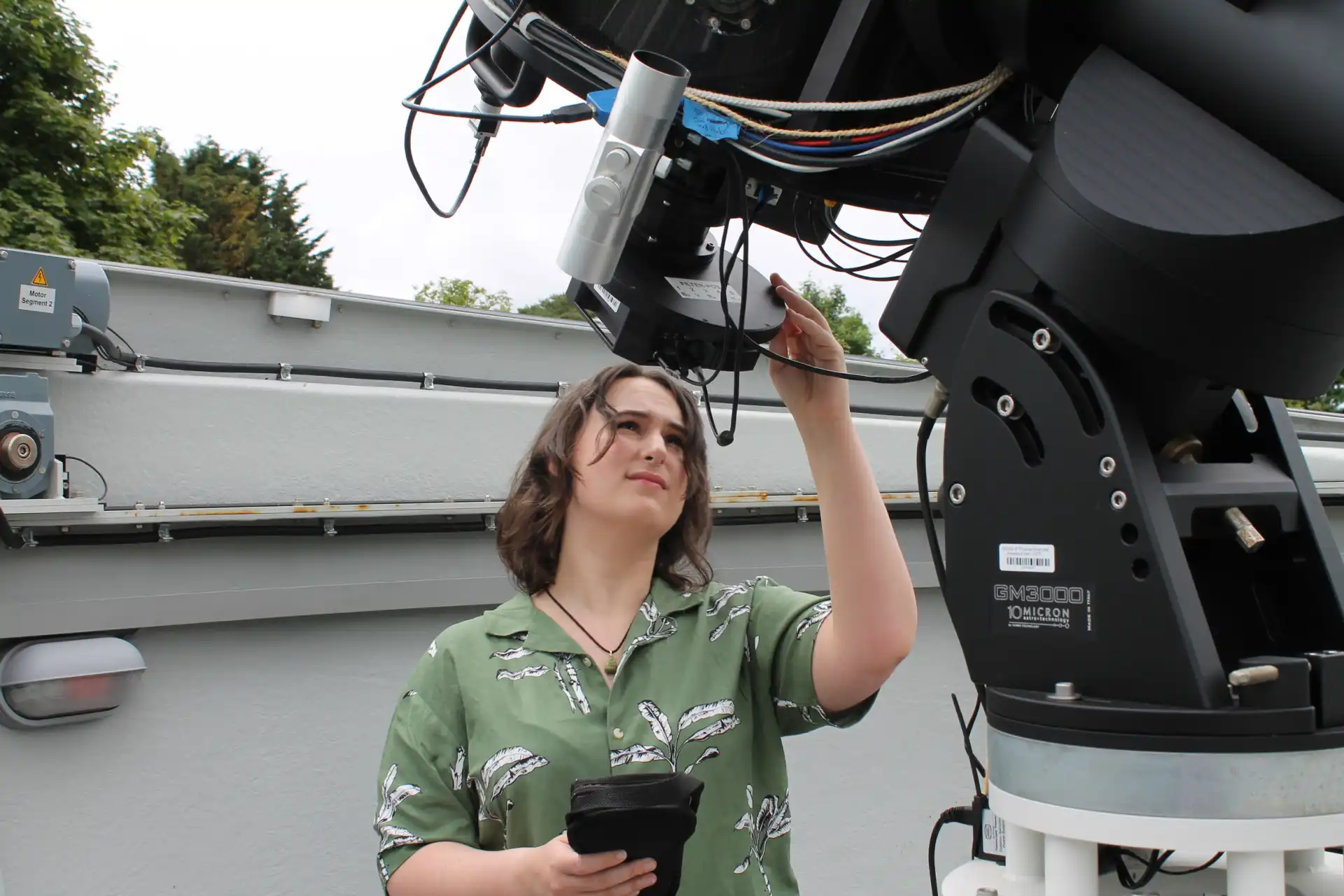
Master the latest equipment in our physics and astronomy labs, workshops and photonics centre, and explore the stars at the Beacon Observatory.
of our Physics research has been classified as “world-leading” or “internationally excellent” (REF 2021).
Hands-on learning
We give you the ability to apply what you’ve learned, whether you’re running lab simulations, analysing astronomical data, or operating our cutting-edge telescope.
At Kent, you’re morethanyourgrades. We look at each student’s circumstances as a whole before deciding whether to make an offer to study here. We also take this flexible approach when we receive your exam results.
Check our Clearing vacancy list or call us now +44 (0)1227 768896 to find out if we have a course that’s right for you. See our Clearing website for more details on how Clearing works at Kent.
The University welcomes applications from international students. Our international recruitment team can guide you on entry requirements. See our International Student website for further information about entry requirements for your country.
If you need to increase your level of science/mathematics ready for undergraduate study, we offer a Foundation Year programme which can help boost your previous scientific experience.
Meet our staff in your country
For more advice about applying to Kent, you can meet our staff at a range of international events.
English Language Requirements
This course requires a Good level of English language, equivalent to B2 on CEFR.
IB Standard Level Grade 5 or above in English A: Language and Literature
A Level Grade C or above in English Language or English Literature.
×
Entry requirements
The University will consider applications from students holding a wide range of qualifications. Click below to find out more.
Typical offer levels
All applications are assessed on an individual basis but some of our typical requirements are listed below. Students offering qualifications not listed are welcome to contact our Admissions Team for further advice. Please also see our general entry requirements.
Additional requirements
112-128 UCAS points
ABB, including A level Mathematics at B (not Use of Mathematics)
The University will consider applicants holding/studying BTEC Extended National Diploma Qualifications (QCF; NQF;OCR) in a relevant Science or Engineering subject at 180 credits or more, on a case by case basis. Please contact us via the enquiries tab for further advice on your individual circumstances.
A typical offer would be to achieve Distinction, Distinction, Merit.
32 points in the IB Diploma or 128 UCAS tariff points , including HL Maths/Maths Methods or HL Mathematics: Analysis and Approaches at 5 or SL Maths/Maths Methods at 6 (not Maths Studies/SL Maths: Applications & Interpretations).
Other qualifications
N/A
The University will consider applicants holding T level qualifications in subjects closely aligned to the course.
The University welcomes applications from Access to Higher Education Diploma candidates for consideration. A typical offer would be to obtain Access to HE Diploma with 45 Credits at level 3 with 30 credits at Distinction and 15 credits at Merit. A Science Access programme including Maths and Physics credits at Level 3 would be required.
×
Fees and funding
Tuition fees for 2026 entry
UK
International
Full-time (UK)
£9,790*
The Government has confirmed that tuition fees in England for Home students will increase to £9,790 from £9,535 for the academic year 2026/27.
Tuition fees may be increased in the second and subsequent years of your course. Detailed information on possible future increases in tuition fees is contained in the Tuition Fees Increase Policy.
For details of when and how to pay fees and charges, please see our Student Finance Guide.
Full-time (International)
£23,500
Fees for year in industry
Fees for undergraduate students are £1,955.
Fees for year abroad
Fees for undergraduate students are £1,465.
Your fee status
The University will assess your fee status as part of the application process. If you are uncertain about your fee status you may wish to seek advice from UKCISA before applying.
For details of when and how to pay fees and charges, please see our Student Finance Guide.
IT Equipment
Students will require regular access to a desktop computer/laptop with an internet connection to use the University of Kent’s online resources and systems. Please see information about the minimum computer requirements for study.
Year in Industry
There may be additional costs associated with the Year in Industry such as travel or accommodation, which will need to be covered by the student. Please see Careers and Employability webpages for more information.
We’ve worked closely with industry and employers to deliver a course that gives you a firm grounding in physics and astrophysics, while providing the specialist insight required for a career in the space industry.
You’ll learn theoretical concepts, put them to use in projects and lab work, and build teamwork, research, and communication skills.
Our space-focused course has prepared students for roles in research and industry, inside and outside the space sector. These include:
Space mission scientist
Research scientist
Space entrepreneur
Earth observation consultant
Systems engineer
Data scientist
Optical engineer
Students have secured positions at a range of companies, such as the European Southern Observatory, Jodrell Bank Centre for Engagement, Rolls Royce, Tesla Engineering, BAE Systems and the NHS.
Graduates entering high-skill roles can earn up to
48%
more than non-graduates. - WEF Future of Jobs Report 2025
A degree can boost average lifetime earnings by over
Our world-class researchers are pushing the boundaries of astrophysics knowledge, in areas from galactic structure, the solar system, space science and planetary nebulae.
×
A cosmic journey
“I feel like I have achieved so much more than I thought possible."
You can apply directly to Kent if you pay international fees, live outside the UK or Ireland and haven’t previously applied through UCAS and don’t intend on doing so.
If you decide to apply direct to Kent, there will be no application fee.