
A 420kg pumpkin, nicknamed Madam Quexzilla Plumpkin, has been grown at the Secret Garden Centre in Birchington with a little help from the microalgae at the heart of a research collaboration between Quex Park and the University of Kent.
Since January, PhD student in the School of Natural Sciences, Abbey Ruffell, has been sponsored by and working with Quex Park to examine whether microalgae can enrich animal feed and soil to produce healthier plants and food while reducing reliance on nitrogen fertilisers.
For these experiments, Liam Cowdery, who runs the Secret Garden Centre with his family, has been farming microalgae in a polytunnel on site, and frequently used the neighbouring pumpkin patch to dump any excess algae.
Whilst the pumpkin was not part of the controlled experiments, the size and quality of the pumpkin does suggest that the microalgae may have had a role in its growth.
“We cut open the pumpkin this morning and the wall is about 6 inches thick,” Liam told us. “It’s also preserved the vibrant orange colour which I’d like to think is due to the carotenoid content in the algae!”
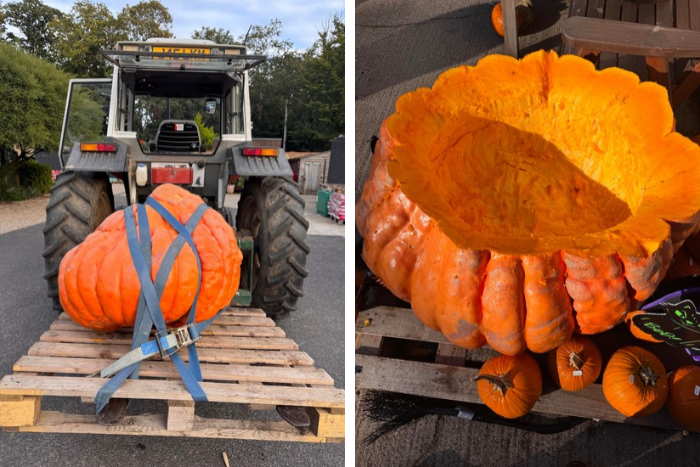
Left: shifting the giant pumpkin. Right: the pumpkin’s rich orange innards unveiled.
Farmers have reported challenges growing pumpkins this summer due to extreme heat and lack of rainfall, with many pumpkins significantly smaller than usual. Growers have also had to contend with the rising cost of nitrogen fertilisers, which remains more than 50% above the 2020 baseline due to conflicts in the Middle East.
There are indications that microalgae could present a more cost-effective means of ensuring crop resilience, whilst reducing the carbon emissions and biodiversity impact associated with traditional fertiliser. To provide evidence of this, Kent’s microbiology researchers will be using the microalgae (chlorella) grown at Quex Park to trial its application across three Kent farm sites growing winter wheat, spring beans and spinach. The project, co-ordinated with support from AgroBioLogic UK, aims to produce transparent data on yield, quality, and nutrient efficiency under real UK growing conditions that can be shared within the sector.
This project is funded by the Department for Environment, Food and Rural Affairs (DEFRA) through the ADOPT farming innovation programme and is led by Dr Anastasios Tsaousis in the School of Natural Sciences.
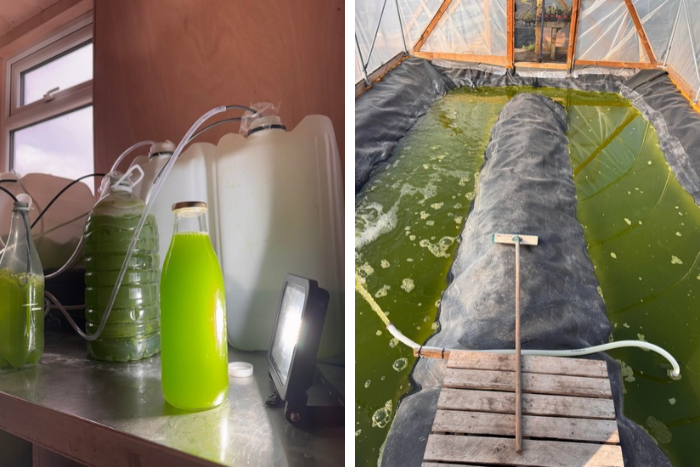
Left: Witches brew or low-carbon fertiliser? Right: farming the microalgae at Quex Park