
Books covering subjects from the benefits of barefoot running to designing peace in Cyprus have been published by University staff.
New titles published from December 2015 to May 2016 include:
- Urban Heritage, Development, and Sustainability, Dr Sophia Labadi and Professor William Logan
- Figures of Death, Professor Paul Sweeting
- Designing Peace: Cyprus and Institutional Innovations in Divided Societies, Dr Neophytos Loizides
- The Body: A Very Short Introduction, Professor Chris Shilling
- The Crisis of Presence in Contemporary Culture, Dr Vincent Miller
- Narratives for Indian Modernity: The Aesthetic of B.M.Anand, Dr Grant Pooke and Aditi Anand
- Through, Professor David Herd
- Footnotes: How Running Makes Us Human, Dr Vybarr Cregan-Reid
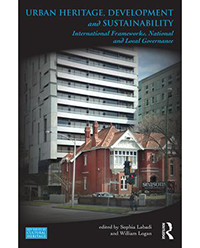 Urban Heritage, Development, and Sustainability
Dr Sophia Labadi, Department of Classical & Archaeological Studies, and
Professor William Logan, Professor Emeritus, Deaking University (Austrialia).
Urban Heritage examines the impact of contemporary challenges such as population growth, mass tourism and unequal access to socio-economic opportunities on urban heritage.
This volume analyses in particular current theories and practices in urban heritage, with particular reference to the conflict between, and potential reconciliation of, conservation and development goals. A global range of case studies detail a number of distinct practical approaches to heritage on international, national and local scales.
Contributions from an international group of authors, including practitioners as well as leading academics, deliver a broad and balanced coverage of this topic. Addressing the interests of both urban planners and heritage specialists, urban heritage, development and sustainability is an important addition to the field that will encourage further discourse.
 Figures of Death
Professor Paul Sweeting, School of Mathematics, Statistics and Actuarial Science
Professor Sweeting has already written a best-selling risk management text book, but Figures of Death is his first novel.
The story starts in Yorkshire with a car crash that kills a prominent businessman Neil Barraclough and his young wife. Detective Inspector Steve Norfolk is called to investigate and discovers that the crash was not an accident, but a well-disguised case of sabotage.
In London, the death of another businessman is appears suspicious. The victim this time is Oliver Fraser, head of Chronosura – an insurance company founded with Neil Barraclough’s money. The prime suspect in Fraser’s death is his colleague, Tom Chambers. However, it soon becomes clear that all of these deaths are connected, and that the killer’s motives are not as clear as they might seem.
 Designing Peace: Cyprus and Institutional Innovations in Divided Societies
Dr Neophytos Loizides, School of Politics and International Relations
Why do some societies choose to adopt federal settlements in the face of acute ethnic conflict, while others do not? Neophytos Loizides examines how acrimoniously divided Cyprus could re-unify by adopting a federal and consociational arrangement inspiring similar attempts in its region.
Dr Loizides asserts that institutional innovation is key in designing peace processes. Analysing power-sharing in Northern Ireland, the return of displaced persons in Bosnia, and the preparatory mandate referendum in South Africa, he shows how divided societies have implemented novel solutions despite conditions that initially seemed prohibitive.
Turning to Cyprus, he chronicles the breakthrough that led to the exhumations of the missing after 2003, and observes that a society’s choice of narratives and institutions can overcome structural constraints. While Dr Loizides points to the relative absence of successful federal and consociational arrangements among societies evolving from the “post-Ottoman space,” he argues that neither elites nor broader societies in the region must be held hostages to the past.
 The Body: A Very Short Introduction
Professor Chris Shilling, School of Social Policy, Sociology and Social Research
The body is an amazing mechanism that enables us to exist, move and function throughout our daily lives, but we often overlook its importance for our social identities, for culture, and for the maintenance and development of societies.
Professor Shilling’s book highlights how ‘body matters’ are key to contemporary social trends and problems, explores the potential of sociology to aid our understanding of embodiment, and identifies some of the multiple reasons why the body has become a source of conflict in the contemporary era.
Professor Shilling’s blog on the body has also been published by Oxford University Press and can be read here and he gave a talk on the body at the Edinburgh Science Festival in April 2016.
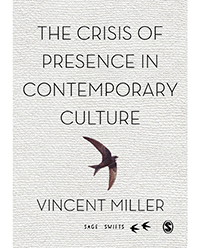 The Crisis of Presence in Contemporary Culture
Dr Vincent Miller, School of Social Policy, Sociology and Social Research
By investigating three issues which have captured the public imagination as ‘problems’ emerging directly from the contemporary use of communications technology (anti-social behaviour, privacy and free speech online), Dr Miller explores how the digital revolution is challenging our notion of ‘self’ and ‘presence’. Through a critical and philosophical examination of each of these cases, he argues that they have at their root the same phenomena: ‘a crisis of presence’.
Focusing on the concept of presence, and the challenges that our changing presence poses to our ethics, privacy and public discourse, Dr Miller illustrates how ubiquitous communication technologies have created a disjuncture between how we think we exist in the world and how we actually do exist through our use of such devices.
The solution, he claims, is not to focus exclusively on ‘content’ and its regulation as much as it is to examine, understand and resist the alienating aspects of the media itself, such as the technological ordering, metaphysical abstraction and mediation which increasingly define our social encounters and presences.
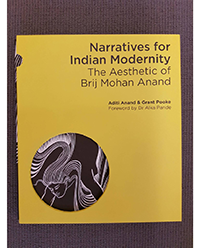 Narratives for Indian Modernity: The Aesthetic of Brij Mohan Anand
Dr Grant Pooke, School of Arts, and Aditi Anand
A landmark exhibition of previously unseen works by the late Indian artist Brij Mohan (B.M.) Anand (1928-1986) was accompanied by a new book by Kent art historian Dr Grant Pooke.
The co-authored monograph with Aditi Anand (no relation to subject), accompanied the inaugural exhibition, Narratives for Indian Modernity: The Aesthetic of B.M.Anand held at Delhi’s India International Centre from 12-22 May 2016.
An accomplished and largely self-taught artist, Anand’s figurative and politicised aesthetic tracked five Cold War decades and India’s emergence as a modern nation state. His life also intersected with some of the events which framed modern India, from the massacre at Amritsar to Partition and Cold War tension.
The monograph draws upon archival research and interviews with family and peers, providing a critical contextualisation of Anand’s scratchboards, following the discovery and partial restoration of a substantial archive of work by the late artist in New Delhi in 2012.
 Through
Professor David Herd, School of English
This new book of poetry by internationally-acclaimed poet David Herd addresses the hostile language that surrounds the reception of people seeking asylum in the UK.
Through considers the ways official public language has set out to undermine human relations. The poems address the cost of such official hostility to human intimacy while re-exploring possibilities of solidarity and trust.
Professor Herd, whose poems, essays and reviews have been published widely, is co-organiser of the Refugee Tales project. He is Professor of Modern Literature, Head of the School of English at Kent.
Previous works by Professor Herd include the collection of poetry All Just (Carcanet, 2012) and Outwith (Bookthug, 2012).
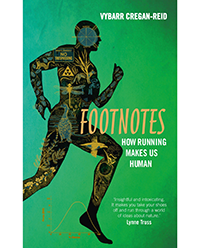 Footnotes: How Running Makes Us Human
Dr Vybarr Cregan-Reid, School of English
Barefoot runner and Kent lecturer Vybarr Cregan-Reid makes a compelling case in a new book for how running can improve our bodies, minds and our hearts.
Footnotes: How Running Makes Us Human explores the simple human desire to run. Using insights from literature, philosophy, neuroscience and biology, Dr Cregan-Reid explores how running has had many different connotations over the years, including exercise, health, marathons and monotony.
He also highlights the importance of people getting off the beaten track, switching off, and opening up their curiosities in a world determined to keep us ‘plugged in and switched on’.
With running in his blood – his uncle won a marathon gold medal for Ireland – Dr Cregan-Reid puts into practice the idea that running is not just a sport but rather a way to reconnect people with their bodies and the environment.