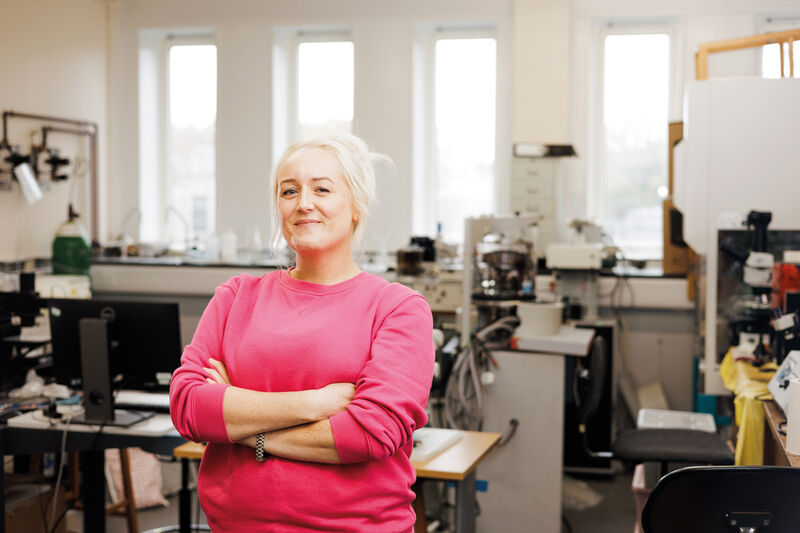
Congratulations to Dr Katy Bruce who has been awarded a UK Intelligence Community (IC) Postdoctoral Research Fellowship from the Royal Academy of Engineering to investigate whether fingermarks could be used to determine not just who was at a crime scene, but when.
Fingermark evidence remains one of the most convincing ways of placing an individual at a particular scene or linking them with a particular object. However, currently there is no clear methodology to determine when a fingermark might have been deposited. Dr Bruce intends to use Polarised Raman spectroscopy to study the geometry and orientational characteristics of components within fingermarks and ‘read’ how they change over time. Her results could finally lead to a clear method that forensic experts can use to determine the age of fingermarks.
Dr Bruce’s new project comes off the back of years of honing her skills in forensic science as an undergraduate and PhD student at Kent, and more recently as a Research Associate and Lecturer. She formerly investigated whether face make-up could be used as a reliable type of trace evidence using a similar Raman spectroscopy technique which she has been teaching to current forensic science students.
The annual Fellowships are awarded by the Government Office for Science to outstanding early career science or engineering researchers and provide a vital link between academia and the intelligence community. In addition to at least two years of financial support for her project, Dr Bruce will benefit from mentoring support, training and networking opportunities within the Royal Academy of Engineering.
Dr Bruce said of the award: ‘I am truly honoured to have been awarded this fellowship, and am hugely grateful to the Royal Academy of Engineering for giving me this amazing opportunity. With this award, I will not only be able to pursue research in an area I love, but also work closely with members of the intelligence community to develop impactful solutions that will hopefully make our society a safer place.’