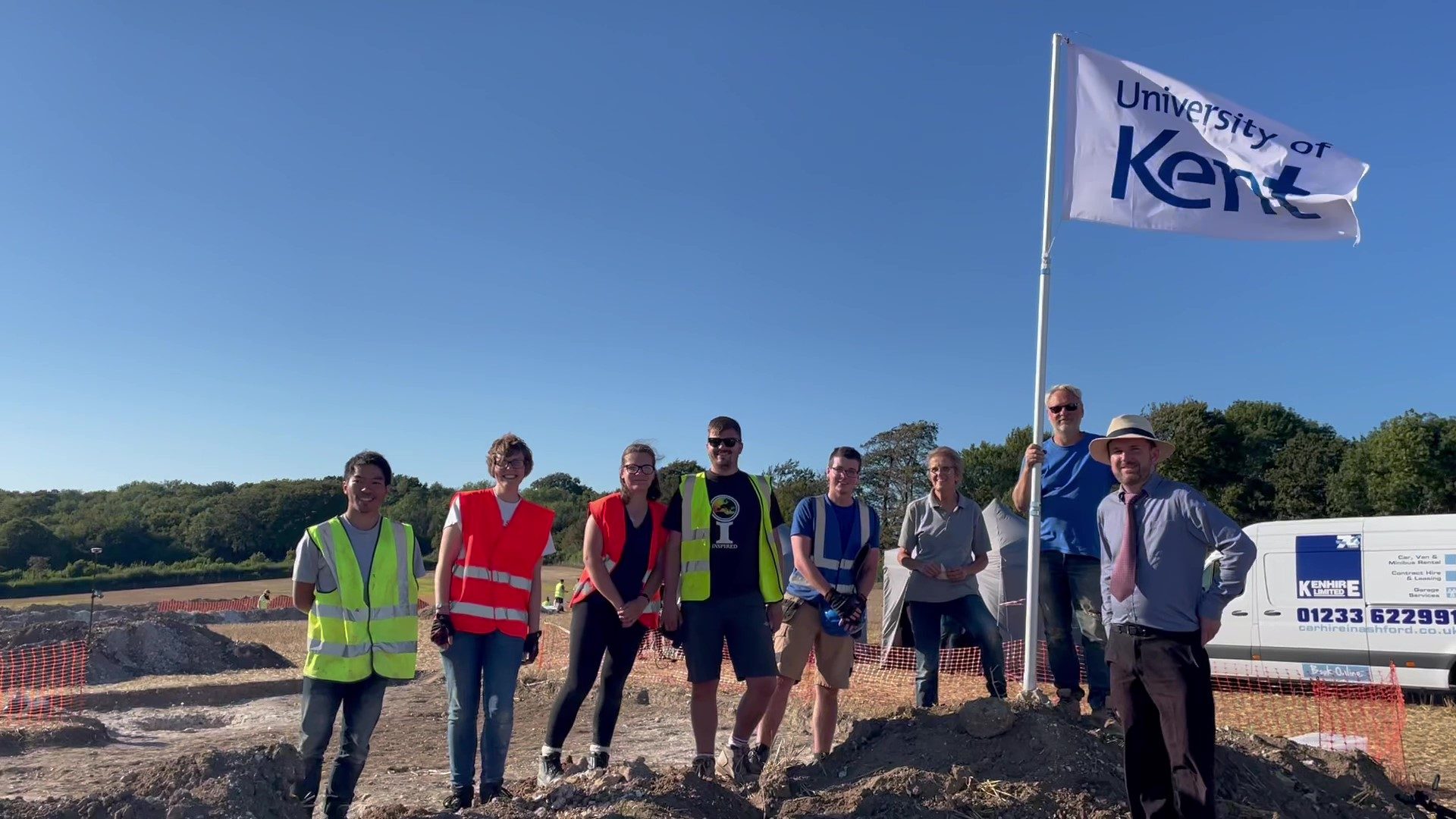
On 3 November, Kent’s Department of Classical and Archaeological Studies will reveal the results of a dig carried out at Swarling, near Canterbury.
The presentation will be given by Dr Luke Lavan in the Templeman Library Lecture Theatre on campus and online via Zoom at 5.15pm.
The Swarling site was chosen as a well-preserved example of a Late Iron Age defended settlement, of which several have been identified around Canterbury. The enclosure forms part of a pre-conquest fortified landscape which may have been built in response to the incursions of Julius Caesar between 55 and 54 BC.
The site is the first Late Iron settlement to be investigated on the eastern part of the North Downs and provides a window onto the landscape just before and just after Canterbury began. It was chosen based on an air photos and geophysics
The excavation, directed by Dr Luke Lavan, was undertaken by 25 students and staff from the Department of Classical and Archaeological Studies, at the invitation of farmer Jo Pickett and with the support of Kent alumnus Paul Dyer.
Student diggers participated for their training in ‘fieldwork practice’, a practical module aimed at preparing them for work on professional archaeological sites, for which this project was a great opportunity.
While the finds, such as imported pottery and iron objects, continue to be analysed in the laboratory, this presentation will include features from three phases of a ditched enclosure, which seem to date within the first two centuries AD. These objects include a cow skull, which may have been buried to ward off evil and protect the site, a ritual oven, and feasting utensils.
The University’s recent work at Swarling, Harbledown and Blean, all similarly fortified sites, is building up a strong picture of the landscape that Caesar saw and that which was created in response to his arrival, by the traumatised inhabitants of East Kent.
Whatever the laboratory reveals in the next few months, it is likely that the defended enclosure at Swarling was not established to resist the Romans but rather to impress locals with a display of martial values, reflecting the courage of Kentish warriors who had experienced the Roman invasion.
Dr Luke Lavan, Lecturer in Archaeology at Kent, said: ‘This was a challenging dig but our students have learnt a great deal in practical skills and in more technical capacities, such as the processing of artefacts. They have had the chance to find daub building materials, iron knives, bangles, and fragments of massive storage jars, in one of the most beautiful parts of Kent. We have some great future archaeologists in development, now with some crucial dig experience, as well as the enthusiasm and ability to take up a job in the subject they are passionate about.
‘The North Downs is very much the local setting of the University of Kent. Through such as this, we hope to unlock the stories of the city and county of which we are a part.’
The access details for the Zoom event are:
Meeting ID: 928 7142 1862
Passcode: 093272