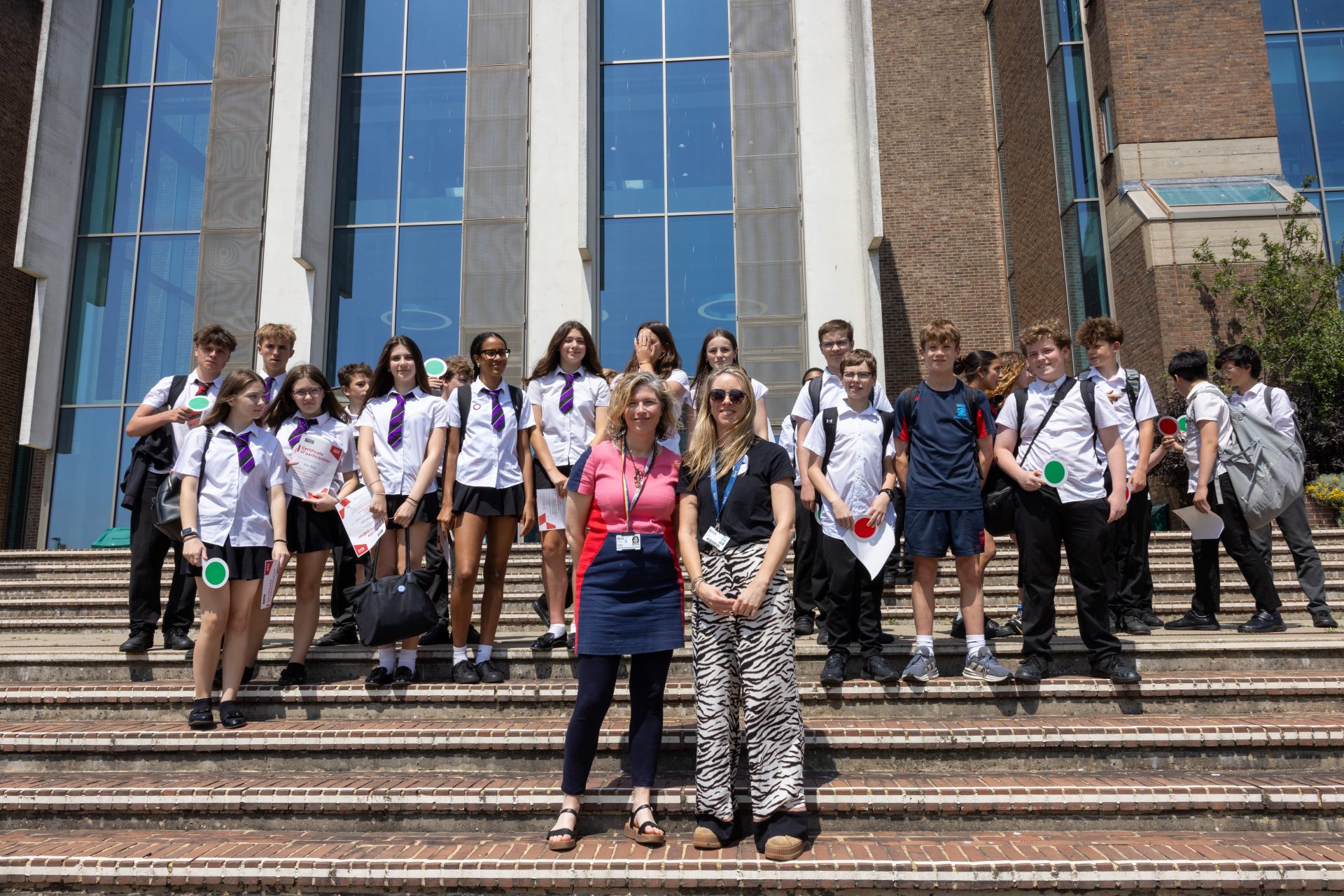
The first findings from a major survey of over 800 young people aged 11-17 about social media have been revealed to local school children today by psychology researchers at an event on the University of Kent’s Canterbury campus.
Dr Lindsey Cameron and Dr Katie Goodbun launched The Alternative Consultation following the success of another project, The Social Experiment, where pupils in Kent secondary schools had the opportunity to swap their smartphones for a ‘brick’ phone for a week and reflect on how they felt.
A consultation that puts young people at its heart
Out of the young people surveyed in The Alternative Consultation, the majority were 11-15 (7.6 % of them were 16 or over). Many recognised that social media can be addictive and can negatively affect wellbeing. At the same time, they described its importance in helping them stay connected with friends, maintain relationships and feel part of their social world. The message from young people was clear: if adults want them to spend less time online, they need more opportunities to spend time offline.
These feelings were echoed by local students when they visited the campus for the launch of the results, where they took part in workshops organised by the University’s Outreach and Widening Participation team.
‘I have to say I completely disagree with this ban,’ one school student shared that morning. ‘They’re punishing children for mistakes that adults are making. It’s not our fault that some people on here are posting disgusting things and we’re the ones being punished for it. They don’t realise that our generation has the fundamentals of social media, we’ve grown up with it, we’ve come to adjust with it… it’s not something to take away from young people. [Social media can be] a really good place to voice concerns or spread awareness of certain subjects or topics.’
Another student reflected: ‘If tech companies had to actually inspect the content they are putting in our algorithms, I think genuinely the internet would be such a safe place.’
Stefan Peto, Assistant Head Teacher at Simon Langton Boys, whose pupils took part in The Social Experiment in 2025, questioned the Government’s approach to consulting young people on the issue: ‘The length of time it took to complete the government survey was a big ask for a young person, and it’s more likely that parents and other adults engaged, even though I’m sure they had the best of intentions. So the danger is that young people’s voices were not captured in the consultation, and as a result, feel that they are not being included in the conversation.’
Celebrating the power of young voices
Speaking to the congregation of young people at the University’s Canterbury campus on Monday, Vice Chancellor, Professor Georgina Randsley de Moura said:
‘Today is a celebration. It is a celebration of your contribution to research on social media and smartphones and a celebration of the importance of ensuring that young people’s voices are heard in conversations about issues that directly affect their lives.
‘We often hear adults talking about social media, smartphones and the impact they have on young people. We hear debates in the media, discussions among policymakers and conversations in schools. Only last week the Prime Minister, Kier Starmer, announced a ban on access to social media for all under 16s. Too often these discussions happen without listening carefully enough to the people who know this reality best, young people themselves, which is why the research and the wider work being showcased today is so important.’
Using psychology to navigate a major societal challenge
94 young people took part in The Social Experiment, from eight schools across southeast Kent; a remarkable challenge: giving up their smartphones for an entire week and replacing them with a simple Nokia phone. Dr Cameron and Dr Goodbun, researchers from the School of Psychology, worked with participants before and after the experience to understand how it affected their feelings, behaviours, relationships, and daily lives. What emerged was a nuanced and fascinating picture.
As Dr Cameron explains: ‘We know that smartphones can bring enormous benefits. They help us stay connected, access information and maintain important relationships. Yet we also know they can be highly addictive and can sometimes be associated with challenges such as disrupted sleep, reduced focus, and impacts on wellbeing. The young people involved in The Social Experiment helped us understand both sides of that story, the benefits and the difficulties, and the important role smartphones play in helping them feel connected to friends and family.’
Alongside this work, The Alternative Consultation ensured that young people’s perspectives were included in discussions about potential policies on social media use. 864 young people aged 11 to 18 from schools across Kent shared their views on social media, online safety, restrictions, wellbeing and what they would like decision-makers to understand about their online lives.
‘What is particularly striking is that the findings point towards thoughtful, balanced approaches,’ continues Dr Cameron. ‘Young people are not simply asking for more freedom or more restrictions. Instead, they are calling for solutions that prioritise wellbeing, involve families, create more opportunities beyond the screen, and encourage safer digital environments. I think there is an important lesson in that for all of us.’
Towards the end of her welcome speech at the event, Professor de Moura reflected on the impact of such research: ‘Research is at its most powerful when it listens. It is at its most valuable when it helps us understand the real experiences of people whose lives are affected by the issues we study. Today is an opportunity not only to share findings, but also to continue that conversation with young people.
‘Thank you to every young person who took part in The Social Experiment and the Alternative Consultation. This event is about celebrating your contribution and learning from your experiences. Your voices matter, and not just today, but in shaping future research, future policy, and future conversations.’