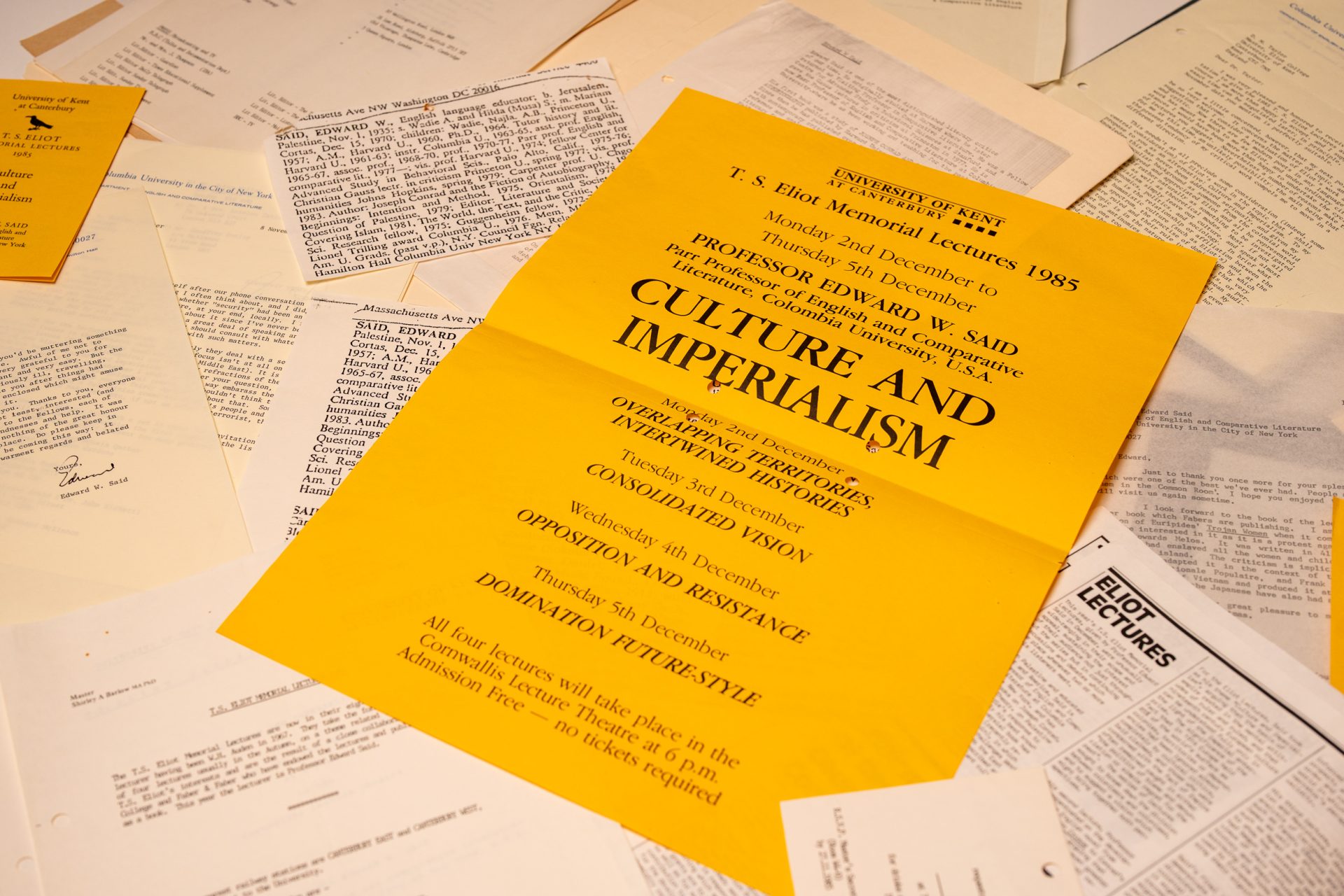
Edward Said, Palestinian-American writer, and founder of postcolonial theory delivered four lectures on campus in 1985, that became the foundation for his seminal work, ‘Culture and Imperialism’.
On 16th May 2026, we gathered, as part of our University of Kent 60th anniversary celebrations, to revisit Edward Said’s T.S.Eliot lectures.
Participants heard Said, in his own voice, as excerpts from the archival original recordings of his lectures were played for researchers, experts, faith leaders, members of the community, alongside special guest Professor Wadie E. Said, Professor of Law at the University of Colorado School of Law, who joined us to speak about his father’s legacy.
Introduction by Jessica Elias – Hearing from Edward Said: extracts from oral archive of his T S Eliot lectures given in 1985 at the University of Kent
Academics respond to Said’s ideas today:
- Prof Wadie Said (University of Colorado School of Law)
- Dr Khawla Badwan (Department of Languages, Linguistics and TESOL, Manchester Metropolitan University)
- Dr Basma El Doukhi (School of Social Sciences, University of Kent)
- Dr Shahd Hammouri (Kent Law School, University of Kent)
- Dr Haifa Mahabir (School of Humanities, University of Kent) (joining online)
Archive material and academic publications available for viewing throughout the day courtesy of Special Collections at The Templeman.
The Legacies of Empire: Intellectual Traditions, International Law, and the Unravelling World Order
Discussing the legacies of Empire and the current changes to the world order and decay of International Law, with dedicated references to Said and Marxism. Expanding to other relevant issues such as the Palestinian question, Ireland, and Said and Philology. Led by Dr Shahd Hammouri (Kent Law School, University of Kent), speakers: Dr Kaveh Abbasian (School of Arts, University of Kent); Dr Conor McCarthy (Department of English, Maynooth University)
The global importance of Humanism: Imperial Contradictions from Culture to Institutions
Exploring one of the core problems that Said investigates in Culture and Imperialism, namely how “Britain’s great humanistic ideas, institutions, and monuments” could co-exist “so comfortably with imperialism”. This will include a discussion of Humanism today – in its cultural, institutional and governmental forms – in an age of neo-imperialism. Led by Dr Matt Whittle (School of Humanities, University of Kent); speakers: Dr Haifa Mahabir (School of Humanities, University of Kent) (joining online); Subhadip Mukherjee (School of Humanities, University of Kent)
The Role of the Public Intellectual in activism and advocacy
Scholar-led roundtable discussion about times of genocide, censorship, silence, accountability, positioning, and active solidarity. Led by Basma El Doukhi (School of Social Sciences, University of Kent), speaker: Dr Khawla Badwan (Department of Languages, Linguistics and TESOL, Manchester Metropolitan University).
The Legacies of Empire: Borders, Labour, and the Reproduction of Colonial Power Today
Discussion on the re-enactment of colonialist practices in border policies and strategies, focusing on refugees, extraction and labour. Led by Dr Maria Ridda (School of Humanities, University of Kent); speakers: Dr Haifa Mahabir (School of Humanities, University of Kent) (joining online); Dr Jasmin Diab (Department of Communication, Mobility and Identity, The Lebanese American University (joined online); Dr Razia Shariff, CEO of Kent Refugee Action Network.
The global importance of Humanism: Palestine, Universal Rights, and the Politics of Solidarity
Discussion on themes related to The Universality of Human Rights, Palestine as a human experience, Humanism and solidarity.
The Crucial question that for this panel – how to truly decolonise Western imagination? Led by Professor Maria Drakopoulou (Kent Law School, University of Kent); Dr Thanos Zartaloudis (Kent Law School, University of Kent) (pre-recorded presentation); Jessica Elias (Kent Law School, University of Kent); Dr Khawla Badwan (Department of Languages, Linguistics and TESOL, Manchester Metropolitan University); Dr Conor McCarthy (Department of English, Maynooth University)
The Role of the Public Intellectual in activism and advocacy
Student-led roundtable – students discussed academic rights and freedom of expression, plus the daunting task of scholarly response-ability, and voice in academia. Led by Dr Basma El Doukhi (School of Social Sciences, University of Kent); speakers: Julie Lecomte (student in School of Humanities, University of Kent); Dr Roberto De Vogli (Department of Developmental Psychology and Socialisation, University of Padova) (joined online)
Final session including remarks by Prof Wadie Said.