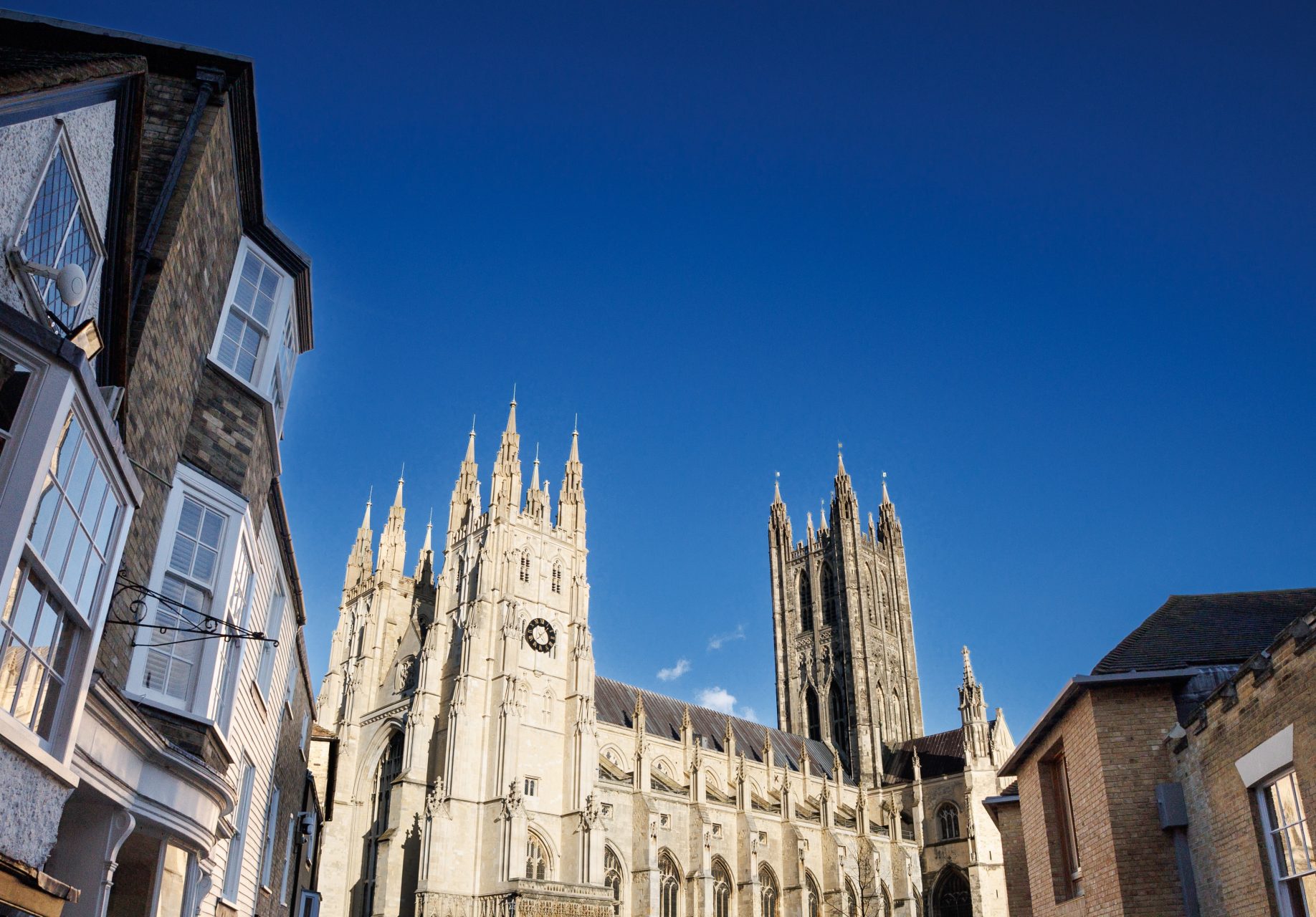
Dr Edward Roberts, Senior Lecturer in Early Medieval History writes about the significance of the elevation of Dame Sarah Mullally to the The See of Canterbury.
‘When on 25th of March Archbishop Sarah Mullally knocks on the west door of Canterbury Cathedral to be admitted and installed as the 106th Archbishop of Canterbury, she will be participating in a service replete with ancient rituals and symbols that can be traced throughout Christian history. As befitting the unique circumstances of her becoming the first woman to hold the office in its 1,400-year history, however, the traditional liturgical elements will be complemented with more innovative and personal aspects.
Inauguration, whether for a secular or spiritual leader, always presents a very public opportunity for a new officeholder to show due reverence for venerable (in this case, millennia-old) custom and to acknowledge the weight of responsibility incumbent on them. Yet such ceremonies also afford a chance to mark individual circumstances or to suggest direction. A look at Archbishop Sarah’s enthronement service in comparison with those of earlier archbishops of Canterbury reveals just how much the Church of England has changed as it bids to modernise and address 21st-century challenges.
In the pre-modern past, the pope and the king played much more significant roles in the election of an archbishop. Canterbury’s earliest archbishops were sent from Rome by popes: among them were St Augustine (597-604), an Italian monk who played a key role in the establishment of Roman Christianity in England, and Theodore (668-90), originally a religious refugee from Syria who became one of the Anglo-Saxon Church’s most influential leaders.
Recognition of the early English Church’s strong bond with Rome was reflected in the fact that, upon election, many medieval archbishops of Canterbury made the arduous journey to Rome to meet the pope and obtain from him the pallium, a woollen band symbolising an archbishop’s authority over other bishops. One of those archbishops, Sigeric, described the itinerary of his journey in the year 990, and this forms the basis of the modern-day Via Francigena, the pilgrims’ way from Canterbury to Rome. Archbishop Sarah acknowledged the historical significance of pilgrimage in the investiture of new archbishops by undertaking her own 140-km pilgrimage from London in recent days.
The Reformation in the sixteenth century decisively ended the pope’s rights over the English Church. Medieval kings of England had always played an important role in the nomination of candidates to the archbishopric, but after Henry VIII became head of the Church of England the monarch’s will prevailed in elections. In modern times, the sovereign’s role is ceremonial, but tradition will be reflected at the service in the reading of a Mandate from Charles III instructing Archbishop Sarah’s installation. The Prince and Princess of Wales and the Prime Minister will be in attendance. Today, the Church of England strives to emphasise solidarity with the Roman Catholic Church, to which end Archbishop Sarah will wear the pastoral ring gifted by Pope Paul VI to Archbishop Michael Ramsey in 1966.
Other aspects of the enthronement reflect the historical circumstances of Archbishop Sarah’s elevation and the Church of England’s global outlook. As the first woman to be enthroned in the office, the date of 25 March was chosen because it is the Feast of the Annunciation, when the Archangel Gabriel visited Mary to announce she would be the mother of the son of God. The new archbishop has personally chosen music for the service that celebrates female composers, musicians and writers through history.
Recent archbishops have sworn the Corporal Oath, a pledge to uphold the ancient rights of Canterbury Cathedral, on an illuminated sixth-century Italian gospel-book known as the St Augustine Gospels, which arrived in England around 600. In a forward-looking break with this tradition, Archbishop Sarah will instead take the Oath on a copy of the recently completed St John’s Bible, the first hand-scribed, illuminated Benedictine Bible produced since the invention of the printing press over 500 years ago. And whereas in the past all proceedings would have been conducted in Latin until the Reformation, and in English thereafter, the service will reflect the Anglican Communion’s global reach with readings, prayers and blessings in six languages, including Spanish, Urdu, and the Bemba language of Zambia.
Archbishop Sarah’s elevation to the see of Canterbury is a historic moment on many levels. Not only will the 100-million-strong worldwide Anglican Communion be led for the first time by a woman, but she will arguably become the most senior female leader within any world religion. On the issue of women holding positions of religious authority, attitudes in the Church of England have changed rapidly. Women only began to be ordained as priests in 1994 and could not become bishops until 2014 – the blink of an eye in the vast sweep of the history of Christianity. The many challenges facing the Church today have been well publicised, but Archbishop Sarah’s election and enthronement demonstrate how the Church is adapting and modernising to meet the demands of a fast-changing society.’
Dr Edward Roberts is giving a public lecture on the medieval Archbishops of Canterbury at Lambeth Palace Library in London on Wednesday 9 April 2026, more can be found here.