Humanity at a Crossroads: Reflecting on Edward Said, Forty Years On 

Grace Shore Banks

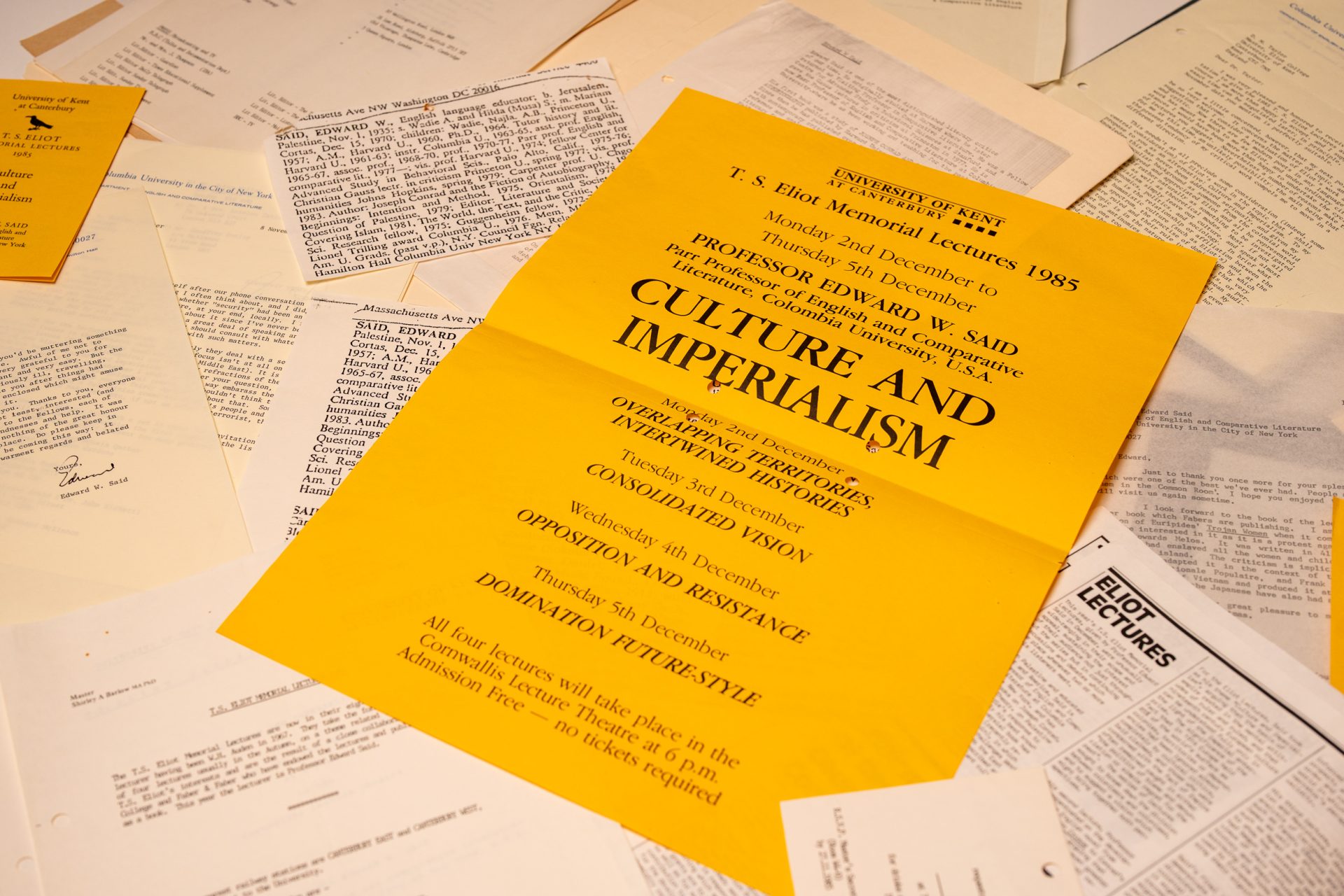
Edward Said, Palestinian-American writer, and founder of postcolonial theory delivered four lectures on campus in 1985 that became the basis for his seminal work, ‘Culture and Imperialism’. On 16 May 2026, we gathered, as part of our University of Kent 60th anniversary celebrations, we revisited Said’s T.S.Eliot lecture. PhD candidate Jessica Elias delivered the opening remarks, reflecting on the significance of Said’s legacy, the rediscovery of the original recordings, and the themes that shaped the day’s discussions. Here is an abridged version:  

“Few authors today are as important and prolific as Edward W. Said.” So wrote Gauri Viswanathan in Power, Politics and Culture. Few intellectuals have shaped the humanities as profoundly. Whether discussing literature, politics, culture, music, or Palestine, Said remains indispensable to any serious conversation about power, representation, and resistance. 

He was the exiled intellectual whose homeland lived in every word. A witness to loss and a weaver of hope. A humanist who became a radical humanist. A literary critic of resistance whose work continues to speak to our present moment. 

In February 2025, while speaking with our archivist in the University of Kent’s Templeman Library about the erosion of international legal principles and the unfolding crises in the Middle East, I clicked on an old recording. Suddenly, Edward Said’s voice filled the archive room. The lectures had been delivered at Kent in December 1985 as part of the T. S. Eliot Memorial Lectures. Hearing that voice across four decades felt less like a discovery than a summons. 

Those lectures—Overlapping Territories, Intertwined HistoriesConsolidated VisionOpposition and Resistance, and Domination Futurestyle—would later form the foundation of Culture and Imperialism. Listening today, they feel remarkably prescient. They speak directly to the overlapping territories, intertwined histories, and enduring structures of domination that continue to shape our world. 

It was therefore fitting that we gathered once again in Canterbury, forty years later, around Said’s voice and legacy. We were especially honoured to welcome Professor Wadie Edward Said, whose concluding reflections connected his father’s intellectual legacy with his own distinguished work in law. 

The University of Kent has long served as a sanctuary for critical thought. Edward Said, Julia Kristeva, Abdulrazak Gurnah, Kazuo Ishiguro, and many others have contributed to a tradition of intellectual courage that remains central to the university’s identity. Organising this symposium during a period marked by war, displacement, and uncertainty often felt challenging, but it also reinforced the importance of universities as spaces for difficult conversations and public engagement. 

Throughout the day, speakers from across the UK and beyond reflected on the legacies of empire, the global significance of humanism, and the role of intellectuals in advocacy and resistance. Together, they explored questions that remain as urgent today as they were in 1985. 

The symposium brought together archives and influence, past and future, literature and politics, law and history. It connected Palestine, Lebanon, Britain, Ireland, and many other places through shared conversations about justice, memory, and responsibility. Most importantly, it reminded us that Edward Said’s work endures not simply because it helps us understand the world, but because it challenges us to change it. Between 1985 and 2026, between archive and action, between memory and possibility, we found ourselves once again at what we called Humanity at a Crossroads. 
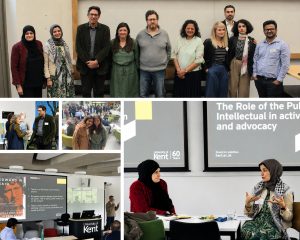
Our sincere thanks go to everyone who contributed to making the symposium possible, including colleagues, students, volunteers, archivists, speakers, guests, and university staff. The event was generously supported by the University of Kent as part of its 60th anniversary celebrations, alongside Kent Law School, the School of Social Sciences, and the School of Humanities. 

For information on speakers at the symposium, some session recordings from the day, and how to access Said’s recordings from the University of Kent archives, please visit the Humanity at a Crossroads webpage. 

Humanity at a Crossroads Symposium 16.05.26 Opening Speech by Jessica Elias  Highlighted in yellow for Nidal’s use if needed. The rest of the text for the other colleagues should they want to publish this speech (thank you note included at the end).Feel free to proofread the English syntax if needed. 

“Few authors today are as important and prolific as Edward W. Said. The author of almost two dozen books, Said has written on a broad array of topics ranging from literary criticism to Middle East politics to opera, film, and travel. Whether the subject is Joseph Conrad, Richard Wagner, or Palestine and the peace process.” This is how Gauri Viswanathan, introduced him in the book of interviews with Edward Said called Power, Politics and Culture.  He has to be quoted in any humanities program of every university on this globe and any book that professes to talk about Cultural Studies, the Middle East, Orientalism, or even the Global South. Also, any responsible intellectual that understands the power of the word– or in other words: the importance of speaking knowledge to power, has to take a leaf from Said’s book.  

He was the exiled, yet a homeland lived in every word. 
A witness to loss like that of the Arab-Israeli 1967 war, and a weaver of hope. 
A revolutionary and the keeper of fragile truths. 
A citizen of nowhere, and the voice of an entire people. 
A humanist turned radical humanist in the 60/70s/80s, a philosopher, a literary critic of resistance.   

One night in February 2025 more than a year ago, I happen to be telling our archivist that the legal institutions humans have put together after the atrocities of the Second World War are crumbling infront of our eyes sounding the alarm of the red lines that have been crossed in the Middle East and the deafening silence of the governments as the legal principles safeguarding humanity as we know it are breached everyday. I go on and click on an mp4 file on the computer in the archive room at our university’s Templeman Library and out came his voice ‘Prof Edward Said ’– a solitary tear coursed down my cheek as I recognised the voice of our thinker and teacher Prof. Edward Said and I understood the message of what needs to be done. I understood that it is not a coincidence that amidst the darkest times that all of us on this planet are facing, he has endowed us with pre-recorded guidance, a sort of ‘message from beyond the grave’ whose time has come. The messages were delivered by Edward Said in December 1985 over 8 hours worth of lectures and mp4. He was invited by our university, The University of Kent, to be part of the TS Eliot memorial lectures – whose name has been also retained in out college: The Eliot college which houses the Law School that I am part of. When the head of Eliot College, Prof. Shirly Barlow, asked him for the titles of his contribution, he came up them with them and sent them in a letter that is displayed outside this theatre mentioned 4 titles each of which would be a 2 hour lecture entitled: OVERLAPPING TERRITORIES, INTERTWINED HISTORIES- CONSOLIDATED VISION- OPPOSITION AND RESISTANCE-DOMINATION FUTURESTYLE.  

These chapters ended up being the core of his seminal book Culture & Imperialism and of course a strange premonition of what we see today in the news and with our communities in the middle east, the overlapping territories, our intertwined histories, our consolidated vision and guidance on how to oppose and resist domination as the empires and their imperialism unfolds. We have with us here today our guest of honor, Prof. Wadie Edward Said, who would be kindly sharing with us the concluding remarks of the day – not only in honor of his father’s legacy Prof Edward Said but also from the perspective of his legal work as a lawyer and Prof of Law at Colorado Law of the University of Colorado.  

The University of Kent offered this space in 1985 for a freethinker and the community of Canterbury and Kent filled the hallways as they heeded the call. It is no coincidence that we meet again today in the same place, around his voice and around his son, and around the same apparatus of human greed, of human fear, of the suppression of life, of steadfastness or “soumoud” صمود as the Palestinians proudly say.  

For this university to be the sanctuary place for thinkers like Prof Edward Said and Julia Kristeva the feminist Bulgarian thinker and many other thinkers that came as part of this renowned TS Eliot series of lectures, is no easy feat. This excellent sanctuary university on top of the hill overlooking England’s central cathedral the Canterbury Cathedral, has had its share of challenges too. IF we were to espouse the imagery of the university being the ship sailing in a raging sea of challenging waves, then we could also see the holes in the bottom floor of the ship literally “rocking the boat.” But there are some able mariners on board, those trained in the art of being intellectuals amidst a world that does not make sense, them making sense for thousands of people one word after another, by clinging on to the ropes of hope like smoke in the air. This ship has had master mariners however like Edward Said and other nearby mariners like Joseph Conrad who is buried also near the university. This ship has had master mariners who have received the Nobel Prize in Literature like Emeritus Prof. Abdulrazak Gurnah  in 2021,as Prof of English and Postcolonial Literatures and Japanese-born British author Kazuo Ishiguro Nobel Prize in Literature in 2017. The journey to make this day possible was also not easy for me a fellow Doctoral Candidate at the Law School, teacher of legal theory and previously Cultural studies, a Lebanese with strong affiliation and loyalty to The University of Kent and the Kent Law School that has supported me throughout my career from 2014 until today. When we had started working on this symposium there was an interlude of ceasefire in the Middle East, the world had changed a lot however the more we advanced towards this day. It was a ship sailing across treacherous waters amidst a backdrop of an apocalyptic war and we on board of the ship had to hang on, all hands on deck as we laboured to have a grip on that deck and the courage to face the storms. In the Odyssey, homer refers to a very effective method for mariners to sail through a sea of fears, he talks about ‘tying oneself to the mast.’ So as not give up to the tempting voices from within or without and to fall off the deck. We had to tie ourselves to the mast of this university-ship, and to keep our eyes on the outcome: which is to share with you this day today like no other day, a historical day.  

When I was searching for the words to write this opening speech, I found myself reading books and listening to your recordings and going over the interviews published with Edward Said in the 80s while reverting to different languages to be able to describe your authorship, your ideas, and your influence on the thinking of the generations that have been influenced by your work.  

Dear Prof. Edward Said if you are with us here today,  

Which languages shall we use to contain the meaning of the nexus you created between between culture and imperialism that does not have one language or mode of operation? Which language helps best encapsulate the diversity of your thinking that pushed through the distinctions of so many academic disciplines from English Literature, to politics, linguistics, history, and even critical legal studies. So much so, you had to create your own discipline – one that goes beyond cultures to see the underpinning connection between representations of culture and oppression- and hence, you became the father of Post-Colonial Studies as we know it, and know it too well. 

Which language suffices to explain the Palestine Question? When every culture has had a role to play in the ensuing process and outcome of the peoples there. 

Which languages shall we use and which cultures suffice to reach the ultimate understanding of the humanities and music? 

Which language to use in this speech and where shall I start? 

When Alice was lost in Wonderland, Lewis Caroll says that the rabbit asked the King: 

«من أين أبدأ يا جلالة الملك؟» سألت.
أجاب بصرامة: «ابدأ من البداية، واستمر حتى تصل إلى النهايةثم توقف». 

 ’Where shall I begin, please your Majesty?’ he asked. ‘Begin at the beginning,’ the King said gravely, ‘and go on till you come to the end: then stop.”   

« Par où dois-je commencer, s’il vous plaît, Votre Majesté ? » demanda-t-elle.
« Commencez par le commencement, » dit gravement le Roi, « et continuez jusqu’à ce que vous arriviez à la fin : alors arrêtez-vous. » 

“This fantastic need for articulation” you said when asked why you strived so hard to learn Arabic in Beirut at my alma mater university there.  

But you knew this would be the case, you yourself had said that the beginnings are the hardest and the most frustrating because to explain Palestine you were effectively being asked to go back to the beginnings, to begin at the beginning again. 

Where, or when, or what is a beginning? If I have to write this opening speech of the 40 years commemoration of the lectures you had kindly given my university and our Eliot college and have left us 23 years ago, where shall I begin? You said in your journal article when you were quoting Levi-Strauss that to identify a point as the beginning is to classify it as the beginning ‘after the fact’ and so the beginning is always somehow left behind.  

Is it the first letter of the word I wrote down, or the word itself, or the sentence that is formed from that first word? Is the year of the Nakba (‘the great catastrophe’) where an estimated 750,000 Palestinians were expelled in 1948 which we commemorated yesterday – the beginning? I could begin with the date you have left your body and let you know that imperialism has destroyed Iraq after years of misrepresentation and international irresponsibility. I could equally begin with October 7th and the ensuing decimation of the Gaza  strip which you knew and warned that sooner or later will be subject to such genocidal intentions. Even as I prepare this speech I google the Ministry of Health’s latest data number to report to you the official size of the victims, the civilians of students, teachers, doctors, engineers, mothers, fathers, children (most importantly children), in Gaza and the google search engine in the United Kingdom makes it difficult for me to access the official website of the ministry of Health in Gaza…the big war machine, as the French philosopher Giles Deleuze would call it, is at work and work it must. 75, 200 your majesty, 75200 that is the number of souls in Gaza taken away and killed, your majesty…  That is 3.2 times the number of students and employed staff at The University of Kent.  

I could begin with the invasion of Israeli invasion of Lebanon in 2025 as in the Israeli invasion of Lebanon in 1982, the invasive memory, the trauma, and the nightmares of walking on ironically named ‘Bliss Street’ in Beirut amidst jasmine tree branches on the walls of the university and smelling the stench of blood instead of the abundant jasmine flowers all over the walls. Where is the beginning?   

Throughout the panel discussions organised for you today by a handful of academics, students, and teachers from all the UK, Ireland, Kashmir, Gaza, and Lebanon – we will attempt to explain and to listen to you as we navigate the beginnings. To that extent, we have organised for you today 6 panel discussions on the legacies of empire, the global importance of humanism, and the role of the intellectual in in activism and advocacy. 

Today knowledge will respond to power 

Today the university makes space for our voices 

Today Kent responds to the silence and the silencing 

Today the local community and the academics will have the conversations that they want and need to have, 

Today we will have a moment to grieve, to commemorate, to teach and to learn 

Today the son will respond to the concerns of the father 

Today the students of Edward Said come together to celebrate his legacy 

Today we will listen and see ourselves in each other. 

Between the past and the future 

Between the archive and influence 

Between the early Said thought and the late Said Thinking 

Between literature, politics, history, and linguistics 

Between Palestine, Gaza, Lebanon, UK, and Ireland 

Between 1985 and 2026 

Between 1935 and 2003 

Between time and space 

We bring you, Humanity at a Crossroads.’