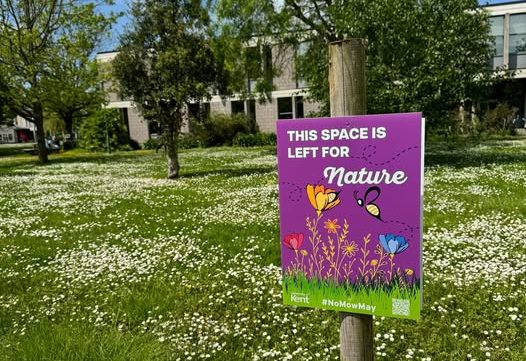
No Mow May, first introduced by Plantlife in 2019 and now supported by over one million UK participants annually, is in full swing at Kent and set to culminate in a community-led campus Bioblitz on Saturday 30 May. But what is that makes these campaigns and others like them so successful?
‘No Mow May is an excellent example of grass roots action for nature,’ says Dr Jake Bicknell, Senior Lecturer on Kent’s Ecology and Conservation BSc. ‘Here our community can really quickly see its impact on flowers and our precious pollinators. It makes me proud to be part of a university that takes its campus biodiversity so seriously.’
Even on a local level, the campaign is making a difference. As Elinor Casey, Sustainability Projects Officer, says: ‘By allowing wildflowers and other plants to grow throughout May, we can not only boost the diversity of plant life and increase our seed bank, but also help support invertebrates, birds and small mammals.
‘Since taking part in No Mow May at Kent, we have noticed an increase in the abundance of plants like bee orchids and pyramidal orchids as well as other native wildflowers. Currently we have recorded just over 680 species of invertebrates living on campus and it is important that we help provide these species with food sources throughout the year.’
This year, the University is supporting the Bumblebee Conservation Trust and Kent County Council to encourage more people to get involved in No Mow May as part of the local campaign ‘Kent’s Plan B’. The grounds team are also trialling ‘Let it Bloom in June’ in select areas of campus.
It’s not just other species that benefit from the campaign. Researchers in the Durrell Institute of Conservation and Ecology have been examining whether No Mow May offers additional benefits to communities. As Dr Jessica Fisher explains: ‘We evaluated people’s responses to the initiative on campus, talking to 74 students, staff and members of the public. Over 85% said they supported No Mow May on campus, which brought them joy and meaning, but others did mention possible risks of hay fever!’
On Saturday 30 May, the unmown areas of campus will be amongst the habitats surveyed at Bioblitz, another participatory event which brings the community together to engage with and support local biodiversity. Organised by students annually, the event gives families, school groups and local community members the chance to survey species across the Canterbury campus alongside Kent scientists, students and local wildlife experts, all with the aim of recording as many species of wildlife as possible.
‘BioBlitz is a magical day of sharing and fostering a love of our biodiversity’ says Sam Maddison, chair of the event and Conservation Science Master’s student. ‘The friendly, community feel of the BioBlitz makes the day feel like a big nature-themed festival. It also provides a unique experience for people to learn about local wildlife from experts in hands-on activities.’
With 310 species having been recorded on campus at the 2025 event, the Bioblitz team will need all the help they can get to beat last year’s record. Those interested in attending can sign up to individual surveys here.