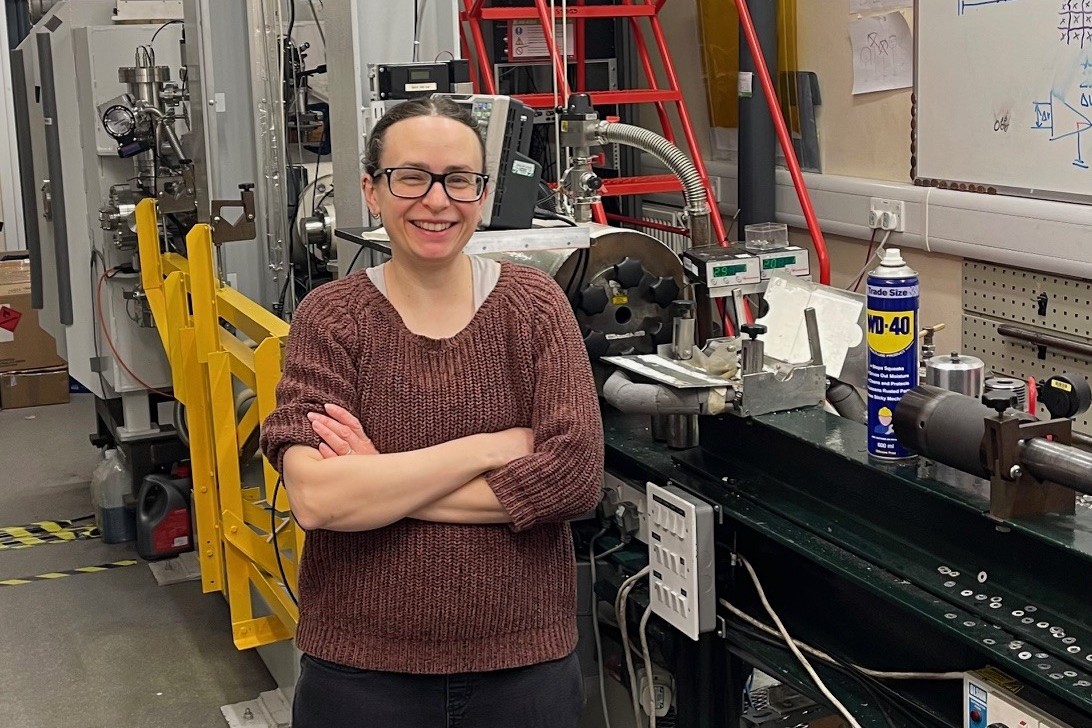
Space Scientist Dr Penelope Wozniakiewicz is set to simulate hypervelocity impacts of space debris on the University campus in a new multi-million pound project funded by the European Research Council (ERC) to address this growing threat to communications and the $469 billion space industry.
As humanity’s reliance on spacecraft and space-based technologies continues to expand, so too does the risk posed by the countless billions of fragments orbiting Earth at speeds of up to 18,000 miles per hour, almost seven times faster than a bullet. These range from tiny flecks of paint and dust to entire rocket stages and discarded satellites, which can present impact hazards and endanger future space missions, GPS, internet access and other vital communications tools down on Earth. Space debris can also burn up and react when de-orbited into the atmosphere, raising environmental concerns.
Dr Wozniakiewicz’s 5-year PROSPER project, funded through the ERC’s 2025 Consolidator Grant, will see her upgrade Kent’s already cutting-edge two-stage light gas gun facility to:
- Simulate what happens when pieces of debris collide with spacecraft;
- Develop new dust detectors for space to measure the number of potentially internet-ending particles; and
- Study what reactions happen when satellites are de-orbited and re-enter our Earth’s atmosphere.
In doing so, Dr Wozniakiewicz hopes to advance the field of ‘sustainable space’ research and support international efforts to manage the problem of space debris.
This technological geohazard has become a central focus for spacefaring nations and their associated agencies worldwide. NASA’s Orbital Debris Program Office estimates there are almost 29,000 trackable objects in Earth’s orbit which can be detected using ground and space-based radar and optical telescopes, allowing for spacecraft to make avoidance manoeuvres. However, debris smaller than radar and optical detection limits is expected to be far more numerous, and still capable of significant damage to spacecraft. It’s this that Dr Penelope Wozniakiewicz is keen to examine.
As she explains: ‘Space debris is one of the fastest-growing threats to the future of space exploration, and PROSPER will give us the means to tackle it safely. With this project, we can generate the high-precision data that agencies and companies worldwide need to build a safer, cleaner, and more sustainable space environment.’
The project builds on 30 years of research in Kent’s Centre for Astrophysics and Planetary Science where the two stage light gas gun has been used to explore hypervelocity impacts in relation to ice, dust and microbes in space. PROSPER will create more opportunities for PhD students and postdoctoral researchers to advance this globally-impactful research on the University of Kent Canterbury campus.