On Stop Food Waste Day (26 April) Dr Robert Barker takes a look at how relationship with food waste, and how we can tackle the problem through a range of innovative solutions and cutting-edge research that is taking place at Kent.
We know that the UK has a huge food waste problem. According to estimates from WRAP, food wasted in the UK across the food supply chain post farm-gate – that is not including the food waste left on farms (more on than in a minute) – amounted to 9.5million tonnes in 2018. This had a value of £19 billion and contributes to approximately 6-7% of greenhouse gas emissions in the UK every year. From leftover food after meals, to having to throw away things that go out of date, most of us our guilty of seeing food wasted first hand in our own homes.
However, that is just the tip of the iceberg. There is waste everywhere along the supply chain – with leftover produce not making it off the farm. From labour shortages to supermarket strategy around price points and quality control (think cheaper wonky fruit and veg), primary food waste (that which is wasted or in surplus so doesn’t ever leave the field) is estimated to amount to 3.6 million tonnes a year.
To find solutions along each step of the supply chain, we need to come up with new initiatives while also looking at waste differently and thinking about how it can be revalorised. At Kent we’re leading initiatives and research to help at each level of this “waste hierarchy”.
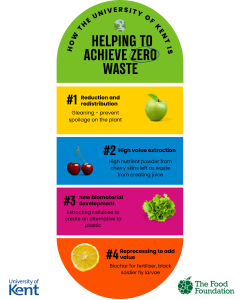
UoK Zero Waste Infographic (1600 × 3000 px)
Using produce as intended – but wasting less
Due to a number of reasons – from supermarket quality control to weather and workforce shortages – food is left to rot on farms. This has a huge economic impact on the farmers, but an environmental one too due to the CO2 released as it rots, not forgetting the carbon footprint of transport used to ship waste produce to a dump. Ensuring that as much produce as possible makes it from field to fork is a “quick win” in combatting food waste. Gleaning projects, like the one recently launched at Kent, can help by redistributing produce to businesses, charities and community. The Kent project, which is organised in collaboration with the student union, will see staff and students volunteer to help harvest surplus produce from local farms. It will use the FoodLoop app – an app developed by Produced in Kent, which connects those who have surplus food with those who need it, and work with charities within a 30-mile radius around Canterbury to make sure that this food still finds a use as it was intended instead of going to waste on farms.
Finding value in the waste
The next step in the hierarchy is using products in a new way, through simple techniques. At home, this is similar to turning often uneaten cauliflower leaves into tasty snacks. On a more technical level, it’s about how we can use science to identify high value products from what we once thought of as waste.
Researchers at Kent were recently awarded UKRI funding working with producers to develop a novel approach to using fruit waste to create new healthy foods, while reducing waste and carbon emissions. With Kent being the largest cherry producer in the UK, the team are perfectly placed to look at how this industry – which often results in waste due to cherries being primarily sold as high-class fresh fruit- can develop new foods from cherry waste while simultaneously understanding and maximising the health benefits of Kent cherry products.
Getting technical – making something new
We can also look at more complex ways of utilising waste – such as making new biomaterials. One of these which we’re particularly interested in at Kent is cellulose. This handy potential waste material can be used to battle the plastic pollution blighting our planet. We are working in the lab to extract the small crystalline parts of natural Cellulose fibres using “green” chemistry which aims to reduce the usage of solvents and energy in the extraction process. Called Cellulose Nanocrystals, this material can then be used as a sustainable coating for packaging materials to increase the shelf life of food or as a biodegradable lining for paper straws helping to make them sturdier, without having to resort to using oil-based plastic alternatives.
Reprocessing and upcycling
The final step is the most complex, and involves reprocessing waste. One example of this is Biochar – an ancient technology that this project is looking to bring into the 21st Century. Instead of burning farm waste, including hedge clippings and tree prunings, it can be converted into biochar. The biochar is a pure form of carbon that can be applied to the land and improve soil health. This research will examine both how to maximise the amount of carbon locked into soils for thousands of years and improvements to soil fertility. The project hopes to increase crop land productivity while reducing atmospheric greenhouse gases by offsetting current fertiliser usage.
In another project we are using Black soldier fly larvae to tackle food waste by creating a more complete system for farms, based around this small but mighty grubs. These larvae are able to eat almost all organic matter and consume twice their body mass every day. By feeding excess and spoilt fruit and veg to the larvae, producers cut their waste directly, the larvae get to work upcycling the waste into a more valuable source of protein that can be used as low carbon feed for animals while the waste from this process can be used as bio-stimulant for crops. This research is optimising the process, allowing farmers and producers to reduce their waste at the same time as reducing their costs and environmental impact by minimising their reliance on unsustainable soy feed for animals which is currently imported from the other side of the World.
Ultimately, this work at every level of the waste hierarchy, which takes a whole-system approach to what we think of as waste and finds new value streams for farmers while simultaneously reducing their environmental impact, will increase the security and sustainability of our food systems for the future. While the scale of the food waste problem is daunting, and requires a multi-pronged approach, the science – and the will – is there to tackle it.