
Research from AMBER, a collaborative Horizon 2020 project coordinated and led by Swansea University with Kent Business School, has found that Europe’s rivers have at least 1.2 million instream barriers.
The results published in Nature show that Europe has probably some of the most fragmented rivers in the world. The study detected thousands of large dams, but also a myriad of low-head structures such as weirs, culverts, fords, sluices and ramps which had been overlooked and are the main culprits of fragmentation.
Using barrier modelling and extensive field ground-truthing, the study estimated that there are least 0.74 barriers per km of stream, and produced the first comprehensive pan-European barrier inventory, the AMBER Barrier Atlas.
Barbara Belletti, leader of the study at Politecnico di Milano, described the extent of river fragmentation in Europe as ‘much higher than anyone had anticipated.’
Jesse O’Hanley, Professor of Environmental Systems Management for Kent Business School, said: ‘Our study shows the real cause of river fragmentation in Europe and the UK isn’t big dams but multitudes of small dams, weirs, and culverts. Walk along your local river and you’re likely to soon come upon one of these structures. Moving forward, among the most important outputs of our project are the various decision support tools we’ve developed to help prioritise the removal and mitigation of river barriers.’
Carlos de Garcia de Leaniz, AMBER’s coordinator, added: ‘Many barriers are obsolete and removing them provides unprecedented opportunities for restoration. Our results feed directly into the new EU Biodiversity Strategy and will help to reconnect at least 25,000 km of Europe’s rivers by 2030.’
AMBER has received funding from the European Union’s Horizon 2020 Research and Innovation Programme under Grant Agreement 689682.
AMBER seeks to apply adaptive management to the operation of dams and other barriers to achieve a more sustainable use of water resources and a more efficient restoration of stream connectivity. The project has developed tools and simulations to help water companies and river managers maximize the benefits of barriers and minimize ecological impacts. AMBER’s main outcomes include:
- Three policy briefs
- Improved fish migration at the Poutès Dam in France using adaptive management strategies
- The removal of unused weirs in the UK, Spain and Denmark
- Several river restoration decision support tools
- The Let It Flow magazine to share research, outcomes, and the vision to reconnect rivers
- Over 25 peer-reviewed publications
- The Barrier Tracker – the first citizen science app to record river barriers across Europe
All AMBER outputs are freely available and can be downloaded from the project website (www.amber.international)
DOI: https://doi.org/10.1038/s41586-020-3005-2
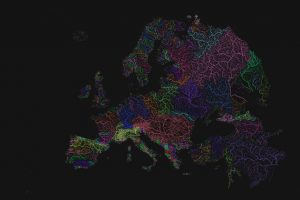
Diagram of Europe’s main river basins