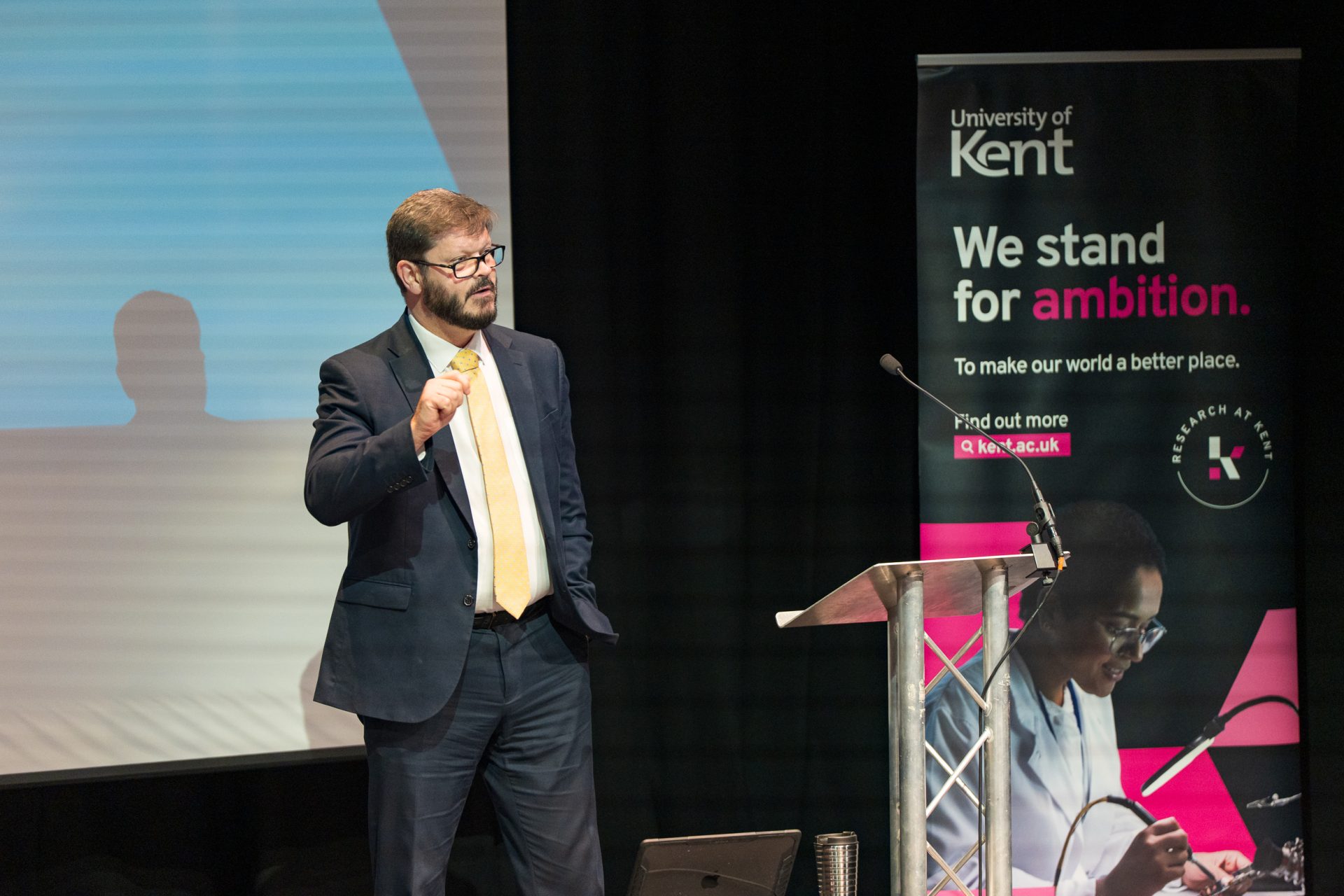
In the December issue of the Chamber of Commerce Thinking Business Magazine, Nicholas Lancaster, Director of Business Development, Research and Innovation at the University of Kent, shared his views on the region’s changing innovation landscape.
The Government’s refreshed Industrial Strategy and the long-awaited Post-16 Education and Skills White Paper mark a turning point in how the UK approaches productivity, skills, and innovation. Both signal a more connected system that links universities, employers, and local government to deliver tangible regional impact.
For Kent and Medway, this represents real opportunity. With recognised strengths in areas such as life sciences, health innovation, creative technology, and sustainable engineering, the region is well placed to translate research into new products, jobs, and social value. The focus now is on how we connect these assets through practical collaboration and shared ambition.
What changes might we see?
Nationally, research and innovation are becoming more mission-driven and place-based. The Government is seeking demonstrable returns on investment – not just academic outputs but measurable benefits to local economies. We can expect stronger alignment of funding with regional priorities, more support for applied research through Innovate UK, and an emphasis on the skills that underpin innovation capacity.
How is the University of Kent responding?
Kent is adapting by integrating research, innovation, and skills into a unified regional offer. We’re growing existing and new partnerships through initiatives such as the health-focussed Applied Research Collaboration across Kent, Surrey and Sussex; the expansion of Knowledge Transfer Partnerships; collaborations with Discovery Park; and the development of Docking Station to support the creative industries in Medway. We’re also embedding enterprise and digital capability within our teaching, ensuring that Kent graduates – and the wider workforce – have the agility to thrive in rapidly changing sectors.
What about the degree versus apprenticeship debate?
That divide is fading fast. The future lies in modular, flexible learning that enables people to move seamlessly between work and study. Our role as a University is to make progression possible at every career stage. By supporting apprenticeships through to postgraduate research, we’re ensuring that local businesses can access the talent and innovation they need to grow.
Your advice for businesses?
Engage early with the region’s universities, invest in your people’s skills, and think collaboratively. Growth now depends on partnerships that turn the UK’s research excellence into regional prosperity. Kent and Medway have the ingredients – knowledge, creativity, and a shared sense of purpose – to lead the next phase of the UK’s innovation economy, and collaborations between Universities and local business are key to making that happen.