
Navigating the job market can be a daunting task, both for those starting out on their career path, and employers seeking talented graduates. James Corbin leads the award-winning Careers and Employability Service at the University of Kent which is creating opportunities for both sides to meet their match and achieve their potential.
How are you preparing students for success in the job market?
Ultimately, we aim to give our students stories they can share with employers. So besides traditional careers advice, we’re creating opportunities for them to connect with employers, experience the workplace and demonstrate the skills they’re expected to before they enter the workplace. This might take the form of in-company experience days, student challenges set by local businesses, or our Employability Festival during which we host more than 100 events over a two-week window. We are also developing new industry panels through which businesses can inform the development of our degree programmes, and inviting them to set tasks for students which can be assessed as coursework.
How are you supporting more inclusive recruitment processes?
As university cohorts have become more diverse, so too has our support for those seeking graduate employment. We have students who come to University and get interviews but don’t go to them because they don’t have the right shoes or can’t afford a shirt. In these instances we can support them through our bursary scheme. We also find that students from non-traditional backgrounds can be alienated by the industry jargon used in job ads. We work with employers to tone this down and manage their expectations of what to expect from a graduate hire.
What advice would you give those who feel unsure about their future career path?
You are not alone! We often say that asking someone what job they want to do is like asking them to describe a colour they’ve never seen as most students have had little exposure to the world of work. In fact, nationally, 40-70% of first year students have no idea what they want to do. It’s also common for students to feel that they might not have the skills for a role, or even not apply because they think there might be stronger applicants. Our focus is on providing support for students and businesses alike to overcome barriers like this, so I would always recommend you approach us and engage in what we have to offer.
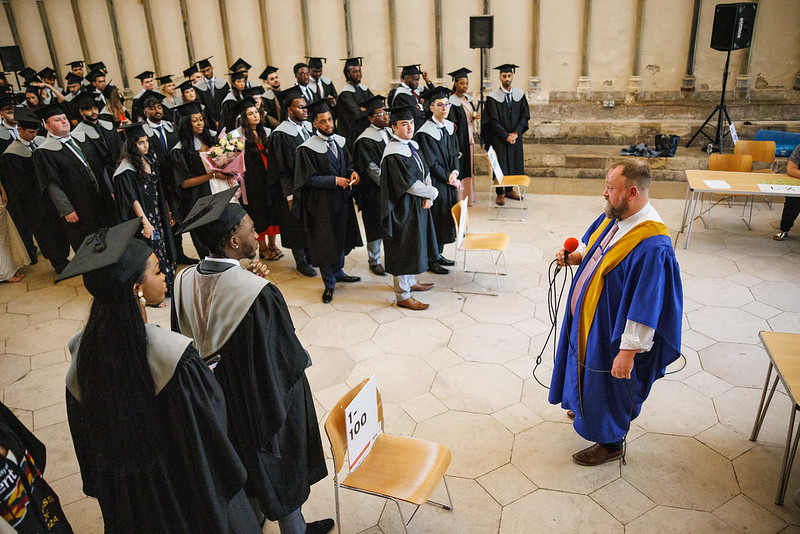
James briefs students on what to expect during their graduation celebrations in Canterbury Cathedral.
What do graduates look for in a job and how can businesses meet their expectations?
When we think about students from the UK, we know that around 42% of the student population both study and stay to work in the place they grew up. So regional talent retention is there – graduates want to stay locally. There is, however, a view from employers that students all want to move to London and we know that isn’t true. To help combat this we run a wide number of events to introduce employers and students, including a careers fair in the spring focussed only on regional jobs. As for international students, we know that the motivators for work and gaining work experience are complex, and so we encourage you to come and see us. We run specific programmes for international students to help you understand the UK labour market, to get insight into the visa options available to you, and to see some of the specific resources we provide to support you.
The challenge for employers is that our students are intelligent, ambitious and hungry people that need to be fed. Salary is one way of doing that, but it’s not everything. Graduates are more concerned with where they can go next, how they can develop and what contribution they can make in the world. They want career progression, interesting work, job security, and good work-life balance. That’s why we work strategically with businesses to create opportunities for them to show how they support new hires, through activities such as careers fairs, talks, work placements and direct involvement in our degrees. We also work very closely with businesses to help them consider ways to create the more supportive environment that new graduates are asking for.
Are work experience and internships still important?
Students need experience – without it, how can they become employable. The problem is that employers are busy and it can feel like a drain on energy and time to run work experience and internships. We provide lots of opportunities for businesses to provide lower impact opportunities to our students, which gives them a chance to tackle real world problems, but in a classroom setting. This can help them solve a challenge they might have, meet potential future employees, and feel good about helping someone bring their education to life. We encourage businesses to approach us to see how an option like this might work for them.