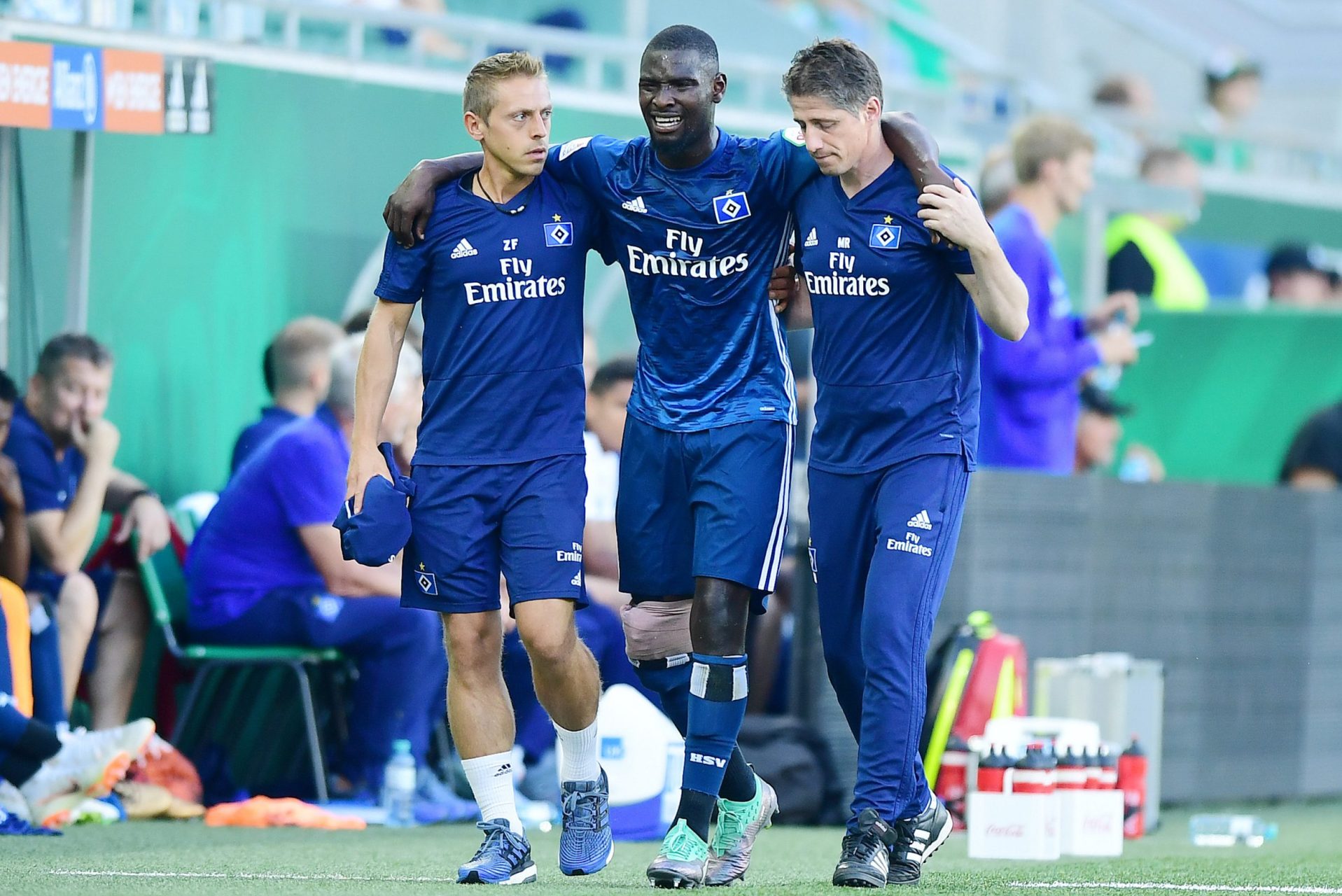
Zacharias (Zachi) Flore from Sport and Exercise Science, has spent the past few years of his PhD working with elite football teams in Germany’s Bundesliga league. Zachi’s career in football physiotherapy and sports science started in 2014 with Werder Bremen’s Elite Youth Academy and professional team, before moving to Hamburger SV in 2015 to work with both their youth and professional teams through to 2023. It was through working with many athletes that he recognised the lack of criteria-based rehabilitation protocols in place and developed his own algorithm for the rehabilitation of lateral ankle sprains. To develop this algorithm for use in professional clubs he needed to test its effectiveness on a large scale, and this is where his PhD came in. Here Zachi tells us more about his PhD and his exciting journey in elite football so far.
What inspired you to pursue studying ankle injury rehabilitation through a PhD?
Lateral ankle sprain (LAS) is one of the most common types of injury in professional footballers, with a high risk of recurrence. By working with players at different levels, I identified the need for evidence based step-by-step (criteria-based) rehabilitation for LAS. The rehabilitation for LAS in professional football is often still time-based and based on the anecdotal experience of the practitioner (e.g. physiotherapist) without any guidelines/criteria of when and why to progress throughout the rehabilitation phase.
This was the starting point when ankle sprain rehabilitation became my topic and passion! I developed a step-by-step rehabilitation algorithm for LAS at Hamburger SV in 2017 but I needed to examine its effectiveness in some depth to bring it into wider practice. Subsequently, I started searching for external supervisors at universities who were interested to support this project.
Tell us a bit more about your rehabilitation algorithm.
Premature return to competition and inadequate rehabilitation are considered to be one of the most important risk factors for a recurrent ankle sprain injury. A criteria-based rehabilitation program could manage rehabilitation and get the athlete back on the pitch as safely as possible, rather than as quickly as possible.
The principle idea of my algorithm is that the athlete has to pass through specific criteria (questionnaire; clinical examination; performance tests) in order to move to a next rehabilitation level. The algorithm takes into account so many different aspects (specific anatomy of the ankle, biomechanics, wound healing stages and kicking progression in the later Return to Sports stages) which make this concept so specific.
How have you tested the algorithm so far?
Our study spans several seasons. First, we performed an observational study to collect reference data on lateral ankle sprains in German Bundesliga Football – a control group. In a second step, the clubs performed our rehabilitation algorithm in case of a lateral ankle sprain occurrence within their club – the intervention study.
The initial observational study incorporated 13 German Bundesliga clubs, 34 teams and 798 players. My research team and I observed 187 ankle injuries, 131 of which were lateral ankle sprain injuries and 34 were recurrent injuries. We are currently waiting for a research paper to be accepted on this study but the feedback from the clubs involved was that the algorithm has had a really positive impact.
How did you find the experience of working with high profile Bundesliga teams and what did you learn?
I visited the clubs both at the beginning of the project (recruiting phase) and at the end to present the results and data. It was interesting to learn a lot and see how other clubs deal with and solve their individual ‘problems’ with LAS injuries – I am really grateful for this open exchange and collaboration with so many helpful and generous people which helped me get a broad overview of the football system. I gained so many insights both into the clubs and the entire Bundesliga league system.
What advice would you give PhD students aspiring to work with high profile football teams?
It is inspiring, fascinating and a privilege to work in the elite football system. Players, teams, colleagues will become a ‘second family’ when working so closely together every day. Nevertheless, it is hard work, with a lot of travelling to away games and training camps at home and abroad, often working around the clock. You have to be very committed and passionate about it. I would also say that you need to make the most of the experiences and opportunities it presents.
Why did you choose Kent to study your PhD?
I got to know my supervisor Dr Karen Hambly at the Isokinetic Conference in London (2019) where I presented the rehabilitation algorithm. I enquired about the opportunity to do my PhD at Kent without any realistic expectations.
However, only a few weeks later I had the opportunity to meet Dr Kyra De Coninck. Both Dr Hambly and Dr De Coninck demonstrated real interest in collaborating with me and were very supportive during the application process. Dr Hambly and Dr De Coninck have both been incredibly supportive and remain a great inspiration for me. I can safely say my decision to do a PhD at Kent was one of the best of my life.
Apart from developing your research, what are the other benefits of doing a PhD?
Studying a PhD is not only to become a specialist in a research field – it is also about developing so many other skills: collaboration; networking; communication; language skills; reading research articles and interpreting research results and (this may be the most important skill) the development of problem-solving strategies. You also gain the experience of conference activities (e.g. presentations), international networking, and; getting to know other countries and cultures.
What do you want to do after your PhD?
I would like to continue bridging practice and scientific research – to stay open minded about alternative directions and opportunities in my career in sports rehabilitation.
In the immediate future I see myself staying in professional football in a physiotherapy capacity, scientifically bringing in all of my experience and knowledge to improve and develop medical teams.
I would also like to experience working with elite leagues in different countries such as the Premier League in the UK.
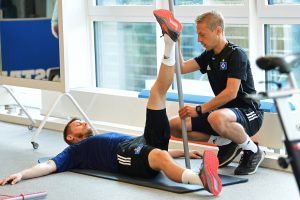
Physiotherapist Zacharias Flore (right) helping footballer Aaron Hunt (left) with injury rehabilitation at Hamburg SV in 2020.