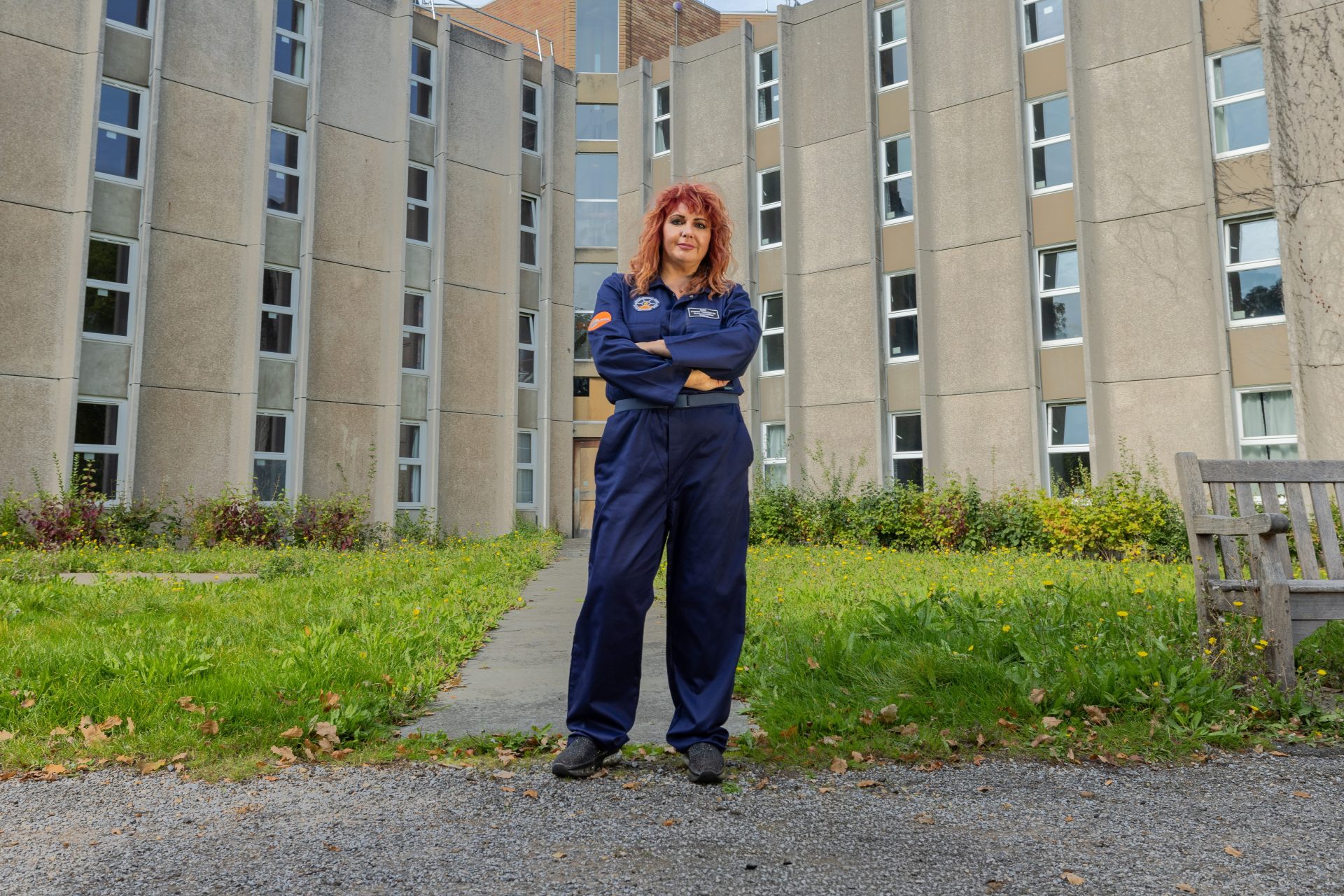
For the majority of us, the dream of going to space is just that; a dream. For Kent graduate Dr Anna Xygkou-Tsiamoulou, it’s the next logical step in her career. As the Director of Space Environmental and Behavioural Systems at Titans Space Industries, and a valued Advisor on the Titans Space Medical Board, she is at the forefront of research into how astronauts can thrive psychologically, socially, and cognitively in deep space. Now, as the world’s first female Greek astronaut candidate with Titans Space Industries, she is not just preparing to explore new worlds; she’s redefining how humanity prepares for life among the stars.
When did you first know you wanted to be an astronaut, and why?
It wasn’t a childhood dream in the classic sense. My desire to become an astronaut emerged from my work with isolated and socially vulnerable populations. As I researched how virtual humans and AI can support mental health, I realized the profound need for psychological and behavioural support in space. I wanted to be part of the solution not only through science but by physically being where the science applies: in space.
Can you describe the moment you found out you’d been selected as an astronaut candidate?
It was surreal. I had been deeply immersed in the COSMIC project, which merges neuroscience, immersive technology, and artificial intelligence to develop AI conversational companions for space missions, when the confirmation came through. There was an overwhelming sense of both pride and responsibility.
How has your Master’s and PhD here at Kent prepared you for astronaut training?
My time at Kent was pivotal. My MSc in Statistics and Research Methods in the School of Psychology laid the foundation for critical analysis, while my PhD in Computer Science refined my understanding of human-technology interaction. More importantly, the focus on immersive environments and conversational AI allowed me to translate abstract theories into real-world applications for astronauts. It taught me not just to analyse problems but to design meaningful, human-centred solutions. Kudos go to my ex-PhD supervisor but above all mentor, Professor Chee Siang Ang, who not only guided me through my PhD but also inspired me and changed my approach to research and way of thinking.
What difference do you want to make with your research in space?
I want to redefine how we think about astronaut wellbeing. My goal is to create intelligent systems that respond empathetically and adaptively to human needs. In deep space, isolation and stress are more than just challenges; they’re existential threats. Through projects like COSMIC, I aim to equip future crews with tools that offer cognitive support, emotional resilience, and a sense of social connection even millions of kilometres from Earth. I am developing intelligent conversational agents (virtual humans or social robots) capable of meaningful and emotionally responsive interaction. Simulating deep-space conditions through analogue missions enables us to gather real-world data on the human-agent interactions we might depend on in space.
I am also leading and coordinating research projects in TITANS SPACE with different groups of astronaut candidates and researchers focussing on biophilic designs in modular space habitats, closed-loop mental and physical health monitoring systems, and inclusive spaceflights and how inclusivity, especially involving “other-able” participants and diverse identities, can contribute to a more adaptive and sustainable model for space exploration.
What part of the training are you most looking forward to, and what are you most nervous about?
I’m genuinely excited about the interdisciplinary collaboration. Working with medical experts, engineers, and psychologists in high-pressure environments excites the researcher in me. That said, I’m naturally a bit nervous about the physical demands. While I’ve trained extensively during analogue missions, the real astronaut programme pushes you beyond limits you didn’t even know you had. But that’s also the beauty of it!
What advice would you give to other students who dream of following in your footsteps?
Stay curious and be persistent. The path to space is rarely linear. Build a strong foundation in your field, but don’t be afraid to step across disciplines; some of the best innovation happens at the intersections. And above all, remember that space needs more than just engineers and pilots; it needs psychologists, communicators, designers; people who understand the human side of the journey.