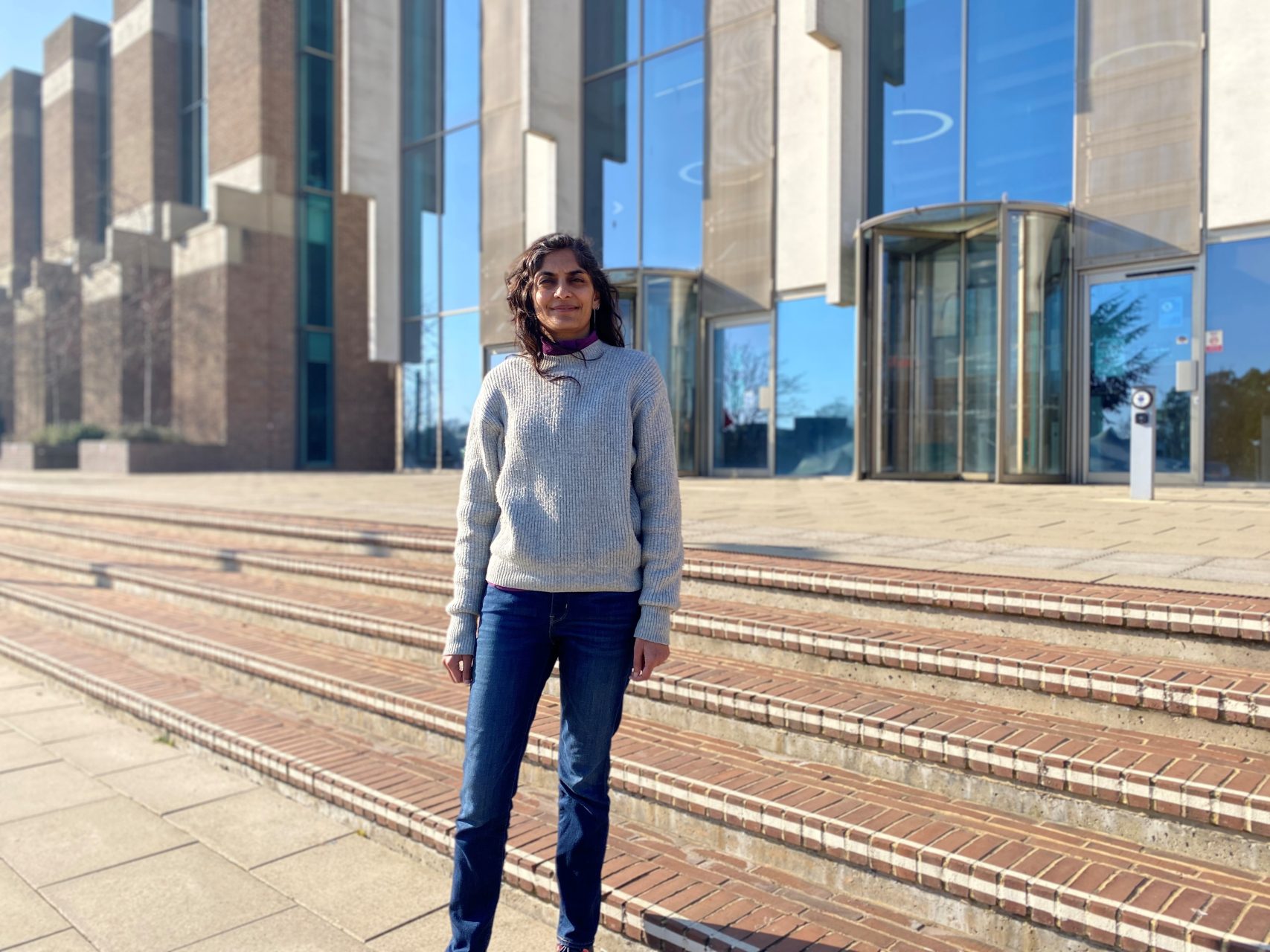
Since 1991, the Charles Wallace India Trust (CWIT) has sponsored an annual Fellowship that enables a writer from India to come and work at Kent for the Spring Term. Hosted by the School of Humanities, the CWIT Fellow is given the time and resources to work on their own creative writing project for up to twelve weeks. Past CWIT Fellows have included prominent novelists Upamanyu Chatterjee, Manju Kapur, Radhika Jha, Ruchir Joshi, the dramatist Mahesh Dattani, the journalist Radhika Iyengar, and leading contemporary Indian English poets such as Vivek Narayanan, Meena Kandasamy and Sampurna Chattarji.
This year, the fellowship was awarded to Aishwarya Iyer, author of The Grasp of Things (Copper Coin/Sublunary Editions, 2023), whose poems, short stories and critical prose have appeared in journals such as Blackbox Manifold, Hakara, Firmament, Almost Island and Poetry at Sangam, among others.
Why did you apply for the fellowship?
There’s an established list of Indian writers who have worked at Kent and subsequently gone on to build up significant and influential bodies of work in a wide variety of literary fields. For me, this fellowship wasn’t just about working in isolation—it felt like an institutional space with a history related to Indian writing. That made it meaningful to apply.
More practically, the fellowship promised the opportunity to spend a consolidated amount of time on reading and developing my manuscript. I have been teaching Literature in India continuously for 17 semesters without a pause so the opportunity to focus on my second book without those teaching commitments was too good to miss.
How has your experience been in Canterbury so far?
Great—surprisingly so given I arrived in winter on 15 January. I have never been to the UK before. I love Canterbury—no high-rises! Coming from a region immersed in 21st-century construction, it’s a very different experience living here. The landscape of Canterbury, the brick houses, and the quiet are refreshing. I love working in the library and my office. The department, especially Matt Whittle, has been very supportive.
Do you think your time in Canterbury will inspire your work?
Definitely, but not necessarily as material for the book. The book itself is rooted in the experience of peri-urban India, so my time here will provide more of a resource for shaping it.
Where is home for you in India?
Currently, I teach Literature at a university in Sonipat, North India, but have moved many cities for work and education, so it’s difficult to answer that question. In a sense, living in several Indian cities has enriched my life deeply, but has also contributed to diasporic anxiety. The longest I have lived anywhere since I was born has been in Sonipat.
The fellowship offers funding for career development. Have you used any of it yet?
Yes. I’ve visited the British Library and the National Poetry Library in London. That travel is funded by the fellowship. This month, I am planning to visit the University of Stirling for a combined reading with the Charles Wallace fellow there. That trip will also be funded.
When is your next reading?
I’ll be presenting some research and reading from my manuscript in mid-March so look out for further details from the School of Humanities!