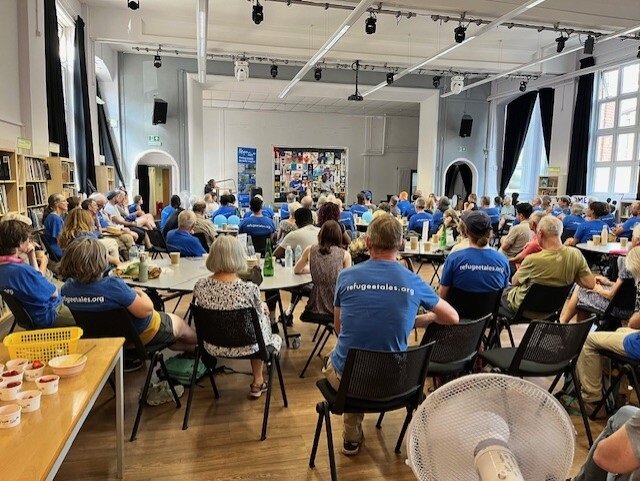
Dr Philip Aghoghovwia, who is working closely with Dr Matthew Whittle from the School of Humanities at the University of Kent, shares his experience of taking part in the Refugee Tales Walk last month – a multi-day walk, inspired by Chaucer’s Canterbury Tales, covering 56 miles around London.
‘This last July, Refugee Tales celebrated 10 years of walking in solidarity to end the indefinite detention of people seeking asylum in the United Kingdom. The UK remains the only country in Western Europe that detains people indefinitely in immigration detention centres, yet the policy has proven to be wasteful and inhumane, contributing to the distress that propels people to leave their homelands in the first instance. Accounts of people who have experienced detention testify to the excruciating experiences of being held in confinement, sometimes for years, while their case for refugee status is determined, during which such individuals are unable to work, move or form social relations.
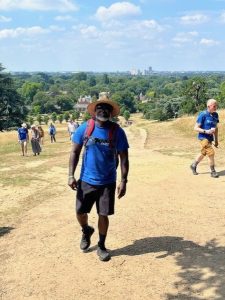
The Gatwick Detainees Welfare Group (GDWG) is a charity organisation calling for an end to this policy. GDWG founded Refugee Tales in 2015, an initiative of walks and storytelling (modelled on Geoffrey Chaucer’s Canterbury Tales) attended by people with lived experience of detention and the charity’s supporters. I was invited to this summer’s Refugee Tales Walk by GDWG’s director Anna Pincus. We walked along the Capital Ring around London: Southwark to Hackney, Hackney to Muswell Hill, Muswell Hill to Kenton, Kenton to Brentford, and Brentford to Wimbledon, covering a total of 56 miles across 5 days from July 9-13.
The practice of fusing multi-day walks with storytelling produced an entirely new vocabulary of protest that I found transformative. I was struck by the high-visibility strategy of protest that refrained from shutting down streets and instead used bright blue t-shirts and caps that made the point of the protest clear. It was profoundly dignified and effective, eliciting curiosity and interest from local onlookers. Rather than walkers making speeches or singing songs, it was the by-passers who initiated the dialogue as they were keen to hear the message that our quiet but visible procession encouraged. This mode of engagement became a conversation between walkers and civil society. Each time the walkers stopped to rest and refresh, the local communities where we stopped showed genuine solidarity, offering services while striking conversations about the walk and its central message of ending indefinite immigration detention.
This solidarity was not merely externalised – as an outward gesture shown by walkers toward a local community of onlookers – but there was also an internal quality to it demonstrated among walkers. We were all open to spontaneous conversations between ourselves, discussing how the walks were something of an ethical wellspring, an event that nourishes the ethics of social relations, affirming a belief in the openness towards the ‘other’, whose presence invited recognition, complementarity, and understanding.
Some of those I encountered explained how their work resonated with the Refugee Tales Walk and the cause for which we were walking: migration and the biases, assumptions, and prejudices that shape its cultural understandings, as well as the government policies — especially in the Global North — that reinforce or respond to these understandings. I encountered some who considered the community of walkers a necessary social aspect of their lives, such that partaking in the walks was a regular event. This applies also to those who attended with their family. Some invited families from mainland Europe, while others flew in from North America (myself included), all converging in London for the 5-day event.
Refugee Tales has yet to realise its aim of ending indefinite detention, but it has stayed the course, thanks to the determination of GDWG and its supporters. That this movement has existed and thrived for 10 years is a testament to the depth of its convictions and the ethical imperatives of its message. It has produced an attentive public in which the experiences of migrants are visible, intelligible, and urgent. At the same time, it has advanced an alternative grammar of protest that eschews spectacle and confrontation in favour of quiet, dignified, and yet clear messaging that leaves its traces on the landscape whilst inviting dialogue as a core ethic of social relation.’
Dr Philip Aghoghovwia is based within the Department of English at Kwantlen Polytechnic University and is Co-Investigator on the British Academy-funded project ‘Environmental Displacements: Climate Migration and Colonialism in African Literature’, led by Dr Matthew Whittle at the University of Kent. This is one of many Kent projects that have focussed on migration and movement, with Refugee Tales amongst them. Emeritus Professor and Nobel Prize winner, Abdulrazak Ghurnah, continues to be a patron of Refugee Tales, co-organised by former Kent professor, David Herd, (now Professor of Literature and Human Rights at the University of St Andrews).