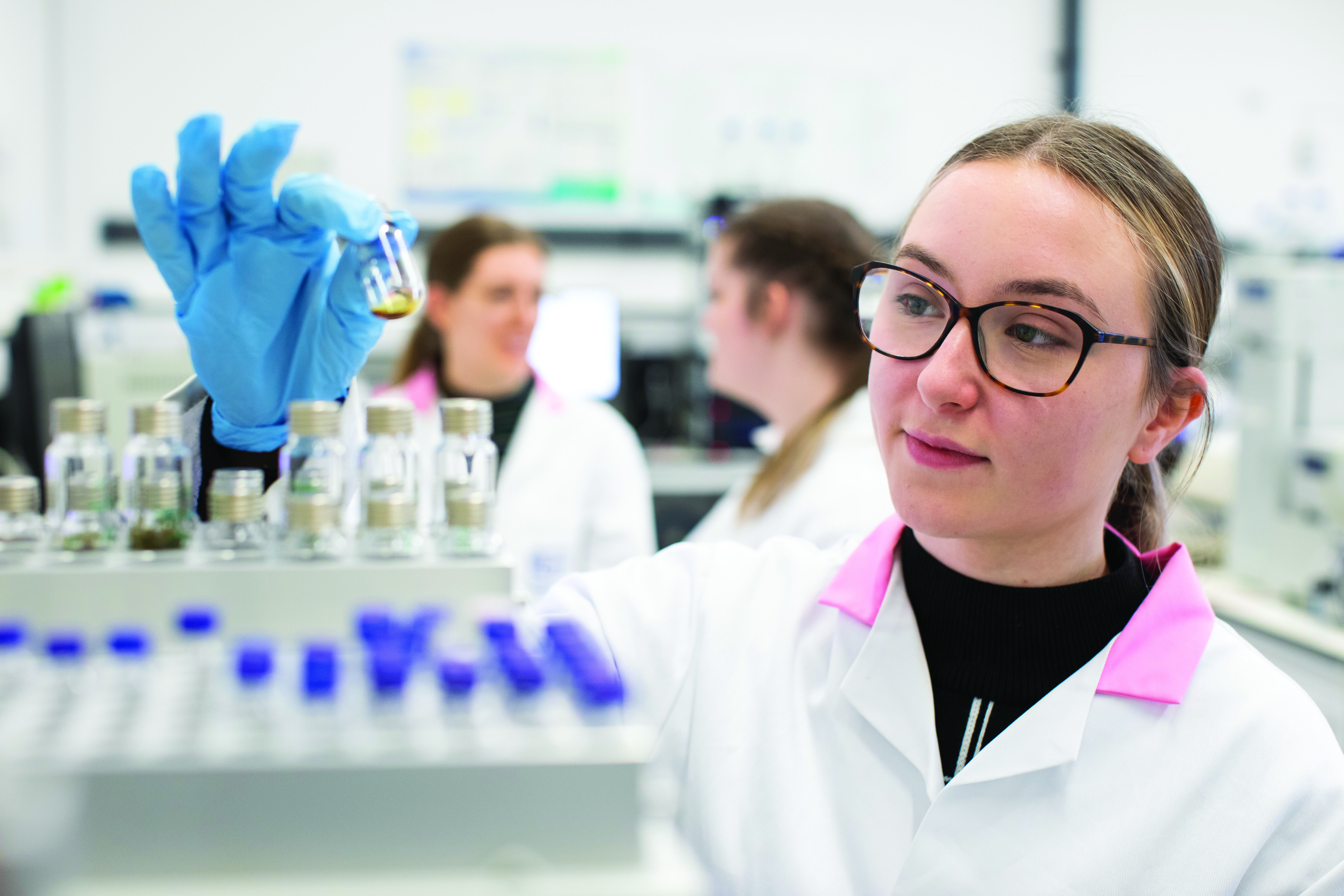
Bethany Jeffery
Chemistry BSc (Hons) and Biochemistry MSc
There is a study hub that provides a quiet study area for both individual and group work. The lab is well-equipped and the lab technicians are always available to help.
Hi Beth! How are things going?
Hi Farradeh! Things are going well, thank you. How are you doing? Thank you for having me here.
I’m doing well, thank you! Great to have you. So tell us a little bit about your Undergraduate (BSc) and Masters (MSc). How have you found the transition?
My BSc was in Chemistry and my MSc is currently in Biochemistry.
The BSc included a variety of teaching, lab work and examinations/coursework. The BSc has given me a great background in chemistry, and taught me a lot of the skills I have been using in my MSc. Within your BSc you gain both wet chemistry and computational lab skills, that are required in further study/work field. In the third year of your BSc you get to choose a research project and experience key applications of your course. For example in my third year I tried to synthesise antimicrobial polymers for use in medical devices. This gave me an idea of what research was like and helped me decide to further my research experience by going into an MSc.
An MSc is a research masters, which means that you do a whole year on a research topic and the grade is determined wholly by a thesis. My current MSc project is to do with synthesising an Antibody Drug Conjugate prototype for treating HER2 +ve breast cancer. This project has both biology and chemistry components, and my chemistry background has definitely aided me in the transition to masters. By doing an undergraduate in chemistry I am used to following lab procedures and have already worked with or know the theory behind a lot of the equipment that is used in my research project.
Wow! It sounds like an amazing project. So what was the most interesting part of your undergraduate?
Within my first year I thoroughly enjoyed the module on biochemistry and drug chemistry. It gave me an insight into the pharmaceutical industry and allowed me to explore one of my possible career paths. After finishing my second year I found that studying chemical identification techniques has aided my knowledge of the equipment used in lab facilities. In addition, the module was joint with forensic science, which gave the school a close-knit, community feeling.
Why did you originally choose Kent? And how come you decided to stay?
I liked how accessible the University is. Within the campus, there are many facilities including the gym, library and nightclub. This allowed my daily life to be filled with lots of activities. Additionally, the main reason I chose to study chemistry at Kent was the course structure. My modules looked enjoyable, and I liked how Kent focused on gaining analytical techniques in the laboratory, which will further my employability for the future.
There are multiple reasons why I decided to stay at Kent for my masters. A key reason was the people I’d met throughout my undergraduate degree. I had grown to know my peers and lecturers well by the end of the three years and I looked forward to continuing my journey at Kent. Another reason was the familiarity of the campus and the friendly atmosphere. The campus has always been lively and I’ve enjoyed going to the many plant and book sales. The final reason for staying was because of my current supervisor’s research interests. I was very intrigued to hear about his research and wanted to stay on so I could get the chance to work with him and most importantly learn from him.
I can see why that would make anyone want to stay! What’s your favourite part of your Masters degree?
I get to work with a vast range of people. In my MSc I have been surrounded by a community of researchers, and by discussing each other’s project’s with one another and watching talks held by academics, I have broadened my understanding of the possible applications of science. I have also enjoyed getting to know everyone on a more personal level, and experiencing a welcoming and friendly environment. This year my research group and I have enjoyed going to Christmas dinner, picnics and a day out at GoApe.
GoApe?? That’s so cool! What do you think of the facilities available to you?
There is a range of facilities on campus for science students. The science study hub is great for practising group presentations or even for a quiet space to finish assignments. If you’re a postgraduate student, the senate building is also available with a kitchenette inside. The labs are well-equipped for both teaching and research. In your undergraduate degree you will get to use a range of state of the art equipment that will aid you in your future careers.
What does a day in your life as a Biochemistry student look like?
A day in my life as a Biochemistry student can include putting on a reaction in the chemistry lab and using analytical equipment to confirm the product has been synthesised. This is then followed by purification techniques. In the biology lab I can be found working with bacteria to synthesise my protein of interest, and performing purification steps and modification reactions with this. My day can also include preparing for outreach projects, demonstrating in the undergraduate labs for chemistry and helping other MSc or new students with their projects.
Do you feel Kent has helped you develop transferable skills, especially highly valued ones like science communication skills?
By joining the student ambassador scheme, I have definitely developed my communication skills. I have been pushed past my comfort zone, and it has allowed me to converse easily with students/parents, but also the lecturers that work a lot of the events. This has in turn developed my scientific communication skills as I have been able to network with the lead academics at Kent. Postgraduate study also helps you build skills that are required at conferences such as poster and presentation skills.
Quickfire Questions!
Best Chemistry/Biochemistry fact?
You can genetically modify bacteria to make your protein of interest for you.
Favourite thing to do on campus?
My favourite thing to do on campus is to visit Mungo’s with my lab group and grab a milkshake.
Best part about Canterbury town centre?
The parks in the town centre. Especially during the summer they are lovely for a picnic. The cathedral is also free to visit as a Kent student and it’s amazing to have your graduation in.
Did you live in university accommodation?
I lived in Turing Houses in my first year of university, and have very fond memories with my housemates. One key memory was having a water fight around the houses.
Find out more about BSc Chemistry and MSc Biochemistry here:
https://www.kent.ac.uk/courses/undergraduate/78/chemistry
https://www.kent.ac.uk/courses/postgraduate/1235/biochemistry